


[Research Report] Analysis of Driving Practices and Public Awareness Survey Regarding the Lowering of Legal Speed Limits on Local Roads




- • Background and objectives of the survey
- • Summary of survey results
- • [Analysis of Driving Patterns] Driving patterns in "residential roads" and "Zone 30" based on people flow data analysis
- • [Driver Awareness Survey] Awareness survey regarding "daily driving" and "reducing legal speed limits on residential roads"
- • [Overall Analysis] Challenges and Prospects for Establishing a 30km/h Speed Limit Based on Analysis of Actual Driving Practices and Awareness Surveys
- Conclusion
- Survey Overview
Background and Objectives of the Survey
On September 1, 2026, with the enforcement of the revised Road Traffic Enforcement Order, the legal speed limit for "residential roads" that lack a center line or designated traffic lanes and are primarily used for the daily lives of residents will be lowered from the current 60 km/h to 30 km/h.
The background to this revision is the tendency for a high proportion of people to be injured or killed while walking or cycling in accidents on residential streets. While measures such as limiting Speed limit to 30 km/h or less on individual roads and designating "Zone 30" and "Zone 30 Plus" have been implemented in the past, this nationwide reduction in the legal speed limit is being implemented as a further safety measure.
(Reference: Details of the reduction in Speed limit on residential roads:)
(https://business.mapfan.com/blog/detail/6017)
Lowering the legal speed limit on residential roads is an important amendment to protect the safety of all road users, including drivers, passengers, pedestrians, and cyclists. With implementation imminent, we conducted a "driving behavior analysis" using the people flow data "Geo-People" and a "driver awareness survey" using location-based questionnaire research "Geo-Research" to clarify the current situation and challenges.
Summary of Survey Results
Awareness and understanding of the system
While approximately 60% of drivers are aware of the reduction in the legal speed limit, less than 10% correctly understand both the "roads affected" and the "speed limit."
Challenges in evaluation and compliance
While approximately 90% of drivers consider the amendments necessary, around 30% feel unsure about complying. The main concerns cited are "difficulty in identifying the affected roads," "pressure from following vehicles," and "road structures that encourage high speeds."
Actual driving speeds on residential streets
In all regions, the most common speed is "30-40 km/h". In Tokyo's 23 wards, about 50% of drivers are driving at "30 km/h or less", while in all other regions, about 60-90% are driving at "over 30 km/h". From September onwards, there are concerns that if drivers continue to drive as they normally would, they may exceed the new legal speed limit (30 km/h).
The effects of Zone 30 and regional differences
Even within "Zone 30" areas, the majority of vehicles travel at speeds exceeding 30 km/h across all regions, and in rural areas (Gunma and Nagano prefectures), speeds exceeding 30 km/h are commonplace, accounting for approximately 70-80% of vehicles. Regional differences are observed in the application and establishment of existing regulations.
Actual usage and perceived risks
20-30% of drivers use residential streets as shortcuts or alternative routes. Perceptions of danger on residential streets vary by region, with approximately 30% of residents in Tokyo's 23 wards reporting having experienced danger from electric scooters.
[Analysis of Traffic Conditions] Traffic conditions in "residential roads" and "Zone 30" based on people flow data analysis
We analyzed the actual driving conditions on "residential roads" and "Zone 30" areas within six regions: Tokyo's 23 wards, Osaka Prefecture, Aichi Prefecture, Fukuoka Prefecture, Gunma Prefecture, and Nagano Prefecture, using people flow data (Geo-People).
<1. Actual driving speeds on residential streets>
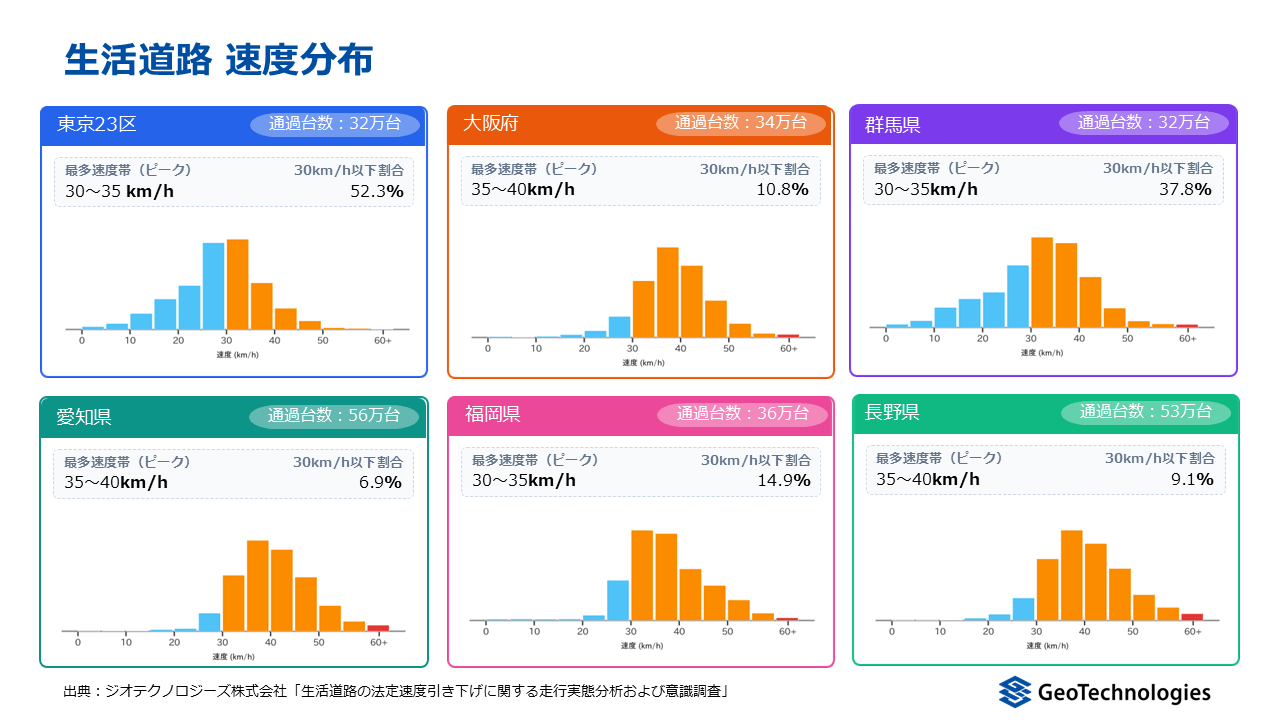
In all regions, the most common speed was "30-40 km/h," with approximately 60-90% of drivers exceeding "30 km/h" in all regions except Tokyo's 23 wards, and only 50% of drivers in Tokyo's 23 wards exceeding "30 km/h."
An examination of actual driving speeds on residential streets revealed that the most common speeds across all regions were "30-35 km/h" or "35-40 km/h." Furthermore, it was found that in all areas except the 23 wards of Tokyo, driving at speeds "over 30 km/h" accounted for approximately 60-90% of the total.
On the other hand, in Tokyo's 23 wards, as mentioned above, although the most common speed range is "over 30 km/h," more than 50% of driving is at "30 km/h or less," indicating a tendency for driving speeds to be suppressed compared to other areas. This reveals that there are regional differences in how people are adapting to the reduction in the legal speed limit.
Safety considerations on local roads and the gap caused by the introduction of the new system
Driving at extremely high speeds, such as nearly 60 km/h, on residential streets is extremely rare, and it appears that most drivers autonomously maintain a certain safe speed (around 30 km/h). However, if this driving situation continues until the speed limit is lowered in September 2026, there are concerns that a gap will arise where drivers exceed the new legal speed limit (30 km/h) even if they are driving with their usual sense of caution.
<2. Speed distribution by time of day on residential roads>
In Tokyo's 23 wards, approximately 50-60% maintain a speed of "30 km/h or less," but in other areas, approximately 60-90% exceed "30 km/h."
An analysis of the time-of-day speed distribution on residential roads revealed a bimodal pattern in many areas, with peaks in traffic volume during the morning and evening. In contrast, in Tokyo's 23 wards, traffic volume rises rapidly in the morning (7-8 am) and continues to increase throughout the day towards the evening peak (5 pm).
Looking at the trends in driving speed, in Tokyo's 23 wards, approximately 50-60% of vehicles travel at "30 km/h or less" throughout the daytime (7:00 AM to 9:00 PM), indicating that slow-moving vehicles are the majority. Even during the peak traffic hours of 5:00 PM, about 50% of vehicles travel at "30 km/h or less," suggesting that speeds are being kept down regardless of the increase in traffic volume.
On the other hand, in all areas outside of Tokyo's 23 wards, regardless of fluctuations in traffic volume, approximately 60-90% of vehicles were traveling at speeds exceeding 30 km/h at any time of day, highlighting the reality that speeds exceeding 30 km/h have become commonplace. In preparation for the implementation of the speed limit reduction in September 2026, daily speed control awareness campaigns that influence local driving environments and driver awareness are needed, regardless of traffic volume or time of day.

<3. Actual Driving Conditions in Zone 30 Areas>
Speeding is the majority of offenses in all regions, and driving at higher speeds is becoming more common in rural areas.
An analysis of speed distribution in "Zone 30" areas, where a 30 km/h speed limit has already been implemented, revealed that the most common speed range in urban areas such as Tokyo's 23 wards, Osaka Prefecture, Aichi Prefecture, and Fukuoka Prefecture is "30-35 km/h," with approximately 50-60% of vehicles traveling at "over 30 km/h" accounting for more than half of the total.
Looking further into rural areas, in Nagano Prefecture, the most common speed range is "35-40 km/h," with approximately 70% of vehicles traveling at "over 30 km/h." In Gunma Prefecture, the most common speed range is "40-45 km/h," with approximately 80% of vehicles traveling at "over 30 km/h." This reveals that the majority of vehicles are exceeding the speed limit (30 km/h).
These results highlight the current situation where speed reductions are insufficient even within Zone 30 designated areas across all regions. The tendency for exceeding the speed limit is particularly pronounced in rural areas compared to urban areas, suggesting regional challenges in the implementation and establishment of existing regulations ahead of the nationwide reduction in legal speed limits in September 2026.

<4. Speed distribution by time of day in Zone 30>
In Tokyo, about 50% adhere to the "30 km/h or less" speed limit, but in urban areas, about 60%, and in rural areas, about 70-80%, exceed "30 km/h."
While an analysis of speed distribution by time of day on residential roads showed an exceptional trend only in Tokyo's 23 wards, the analysis of Zone 30 revealed a "bimodal" trend with clear peaks in the morning (around 8am) and evening (around 5pm) in all areas, including Tokyo's 23 wards.
Regarding the driving speeds in Zone 30 by time of day, in Tokyo's 23 wards, approximately 50% of vehicles are traveling at "30 km/h or less" during the daytime (7:00 AM to 9:00 PM), indicating that slow-moving vehicles are the majority. This figure remains at approximately 50% even during the peak traffic time of 5:00 PM.
In urban areas such as Osaka Prefecture, Aichi Prefecture, and Fukuoka Prefecture, approximately 60% of vehicles travel at speeds exceeding 30 km/h during the daytime, and even during the peak traffic hours around 5 PM, approximately 60% of vehicles are still traveling at speeds exceeding 30 km/h.
On the other hand, in rural areas such as Gunma and Nagano prefectures, approximately 70-80% of vehicles travel at speeds exceeding 30 km/h during the daytime. This percentage remains unchanged even during the peak hours around 5 PM, revealing that even within the Zone 30 restricted areas, speeds are not consistently reduced.
This highlights that even within clearly regulated zones like Zone 30, there are differences in the level of adoption and actual driving conditions from region to region.

[Driver Awareness Survey] Awareness survey on "daily driving" and "reducing legal speed limits on residential roads"
We conducted a survey on attitudes towards daily driving and the reduction of legal speed limits on local roads, targeting 4,994 drivers in Tokyo's 23 wards, Osaka Prefecture, Aichi Prefecture, Fukuoka Prefecture, Gunma Prefecture, and Nagano Prefecture, using the location-based survey research service "Geo-Research".
<5. Awareness and understanding of the reduction in the legal speed limit: While awareness is around 60%, the correct answer rate for specific details is less than 10%>
Regarding the reduction in the legal speed limit on residential roads, which will be implemented from September 2026, approximately 60% of people across all regions are aware of it, but only about 15% responded that they "know the details, including the specifics."

Furthermore, less than 10% of respondents across all regions were able to correctly identify both the roads subject to the speed limit reduction and the legal speed limits before and after the change. Even among those aware of the system, the correct answer rate remained at approximately 10%.
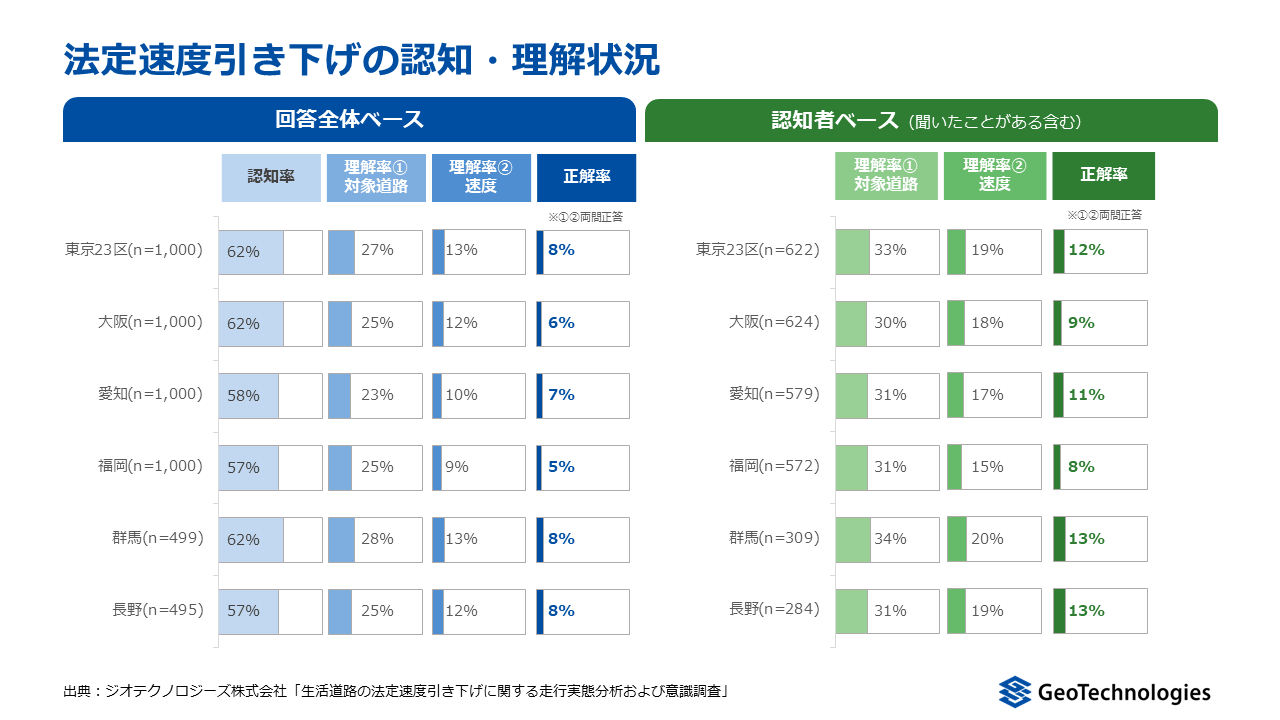
Looking at the level of understanding for each item, the correct answer rate for the "roads affected" by the speed limit reduction was just over 20% in all regions, with about half responding "I don't know." Furthermore, the correct answer rate for the "legal speed limit (30 km/h)" before and after the change was even lower, at around 10% in all regions, with more than half responding "I don't know."

These results highlight that while awareness of the system itself is increasing, there is still a lack of accurate understanding of the specific details, such as which roads are subject to the regulations and the speed limits.
<6. Evaluation of lowering the legal speed limit on residential roads: While 90% support the system, around 30% are concerned about compliance.>
In all regions, approximately 90% of respondents considered the reduction of the legal speed limit on residential roads to be a "necessary amendment." On the other hand, more than 30% of respondents said they "think it's necessary, but are worried about complying with it," indicating that while there is support for the system, a significant number of people feel uneasy about actually complying with it. Negative responses regarding the amendment were limited to about 10%.

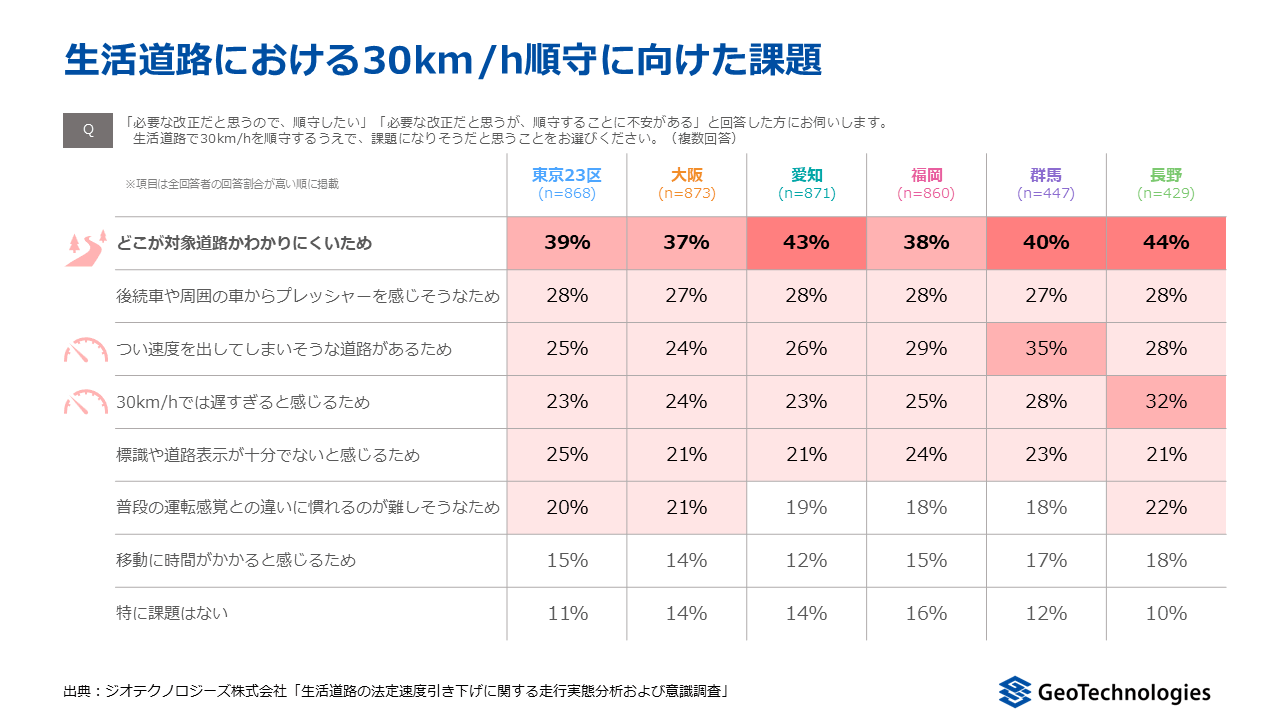
<7. Challenges to ensuring 30 km/h speed limits on residential roads: The biggest obstacle is "difficulty in identifying the target roads (approximately 40%)">
Regarding the challenges of adhering to the 30 km/h speed limit, the most common response in all regions was "It's difficult to know which roads are subject to the limit," cited by approximately 40% of respondents in each region. This was followed by "I feel pressured by following and surrounding vehicles" (approximately 30%) and "There are roads where I might unintentionally speed up" ("There are roads where I might unintentionally speed up"). This suggests that not only is awareness of the rule a barrier, but psychological factors and the road environment are also obstacles to compliance.
<8. Reasons for using local roads: While the main reason is to use them along the route to the destination, 20-30% use them as a "shortcut">
In all regions, the most common reason drivers use "local roads" was "because their home or destination is located along a local road." This was followed by "because it's a familiar road they've used for a long time," suggesting that local roads are used as everyday routes. On the other hand, 20-30% responded that they use them "as shortcuts or alternative routes," indicating that local roads are also used as shortcuts or alternative routes in some cases.

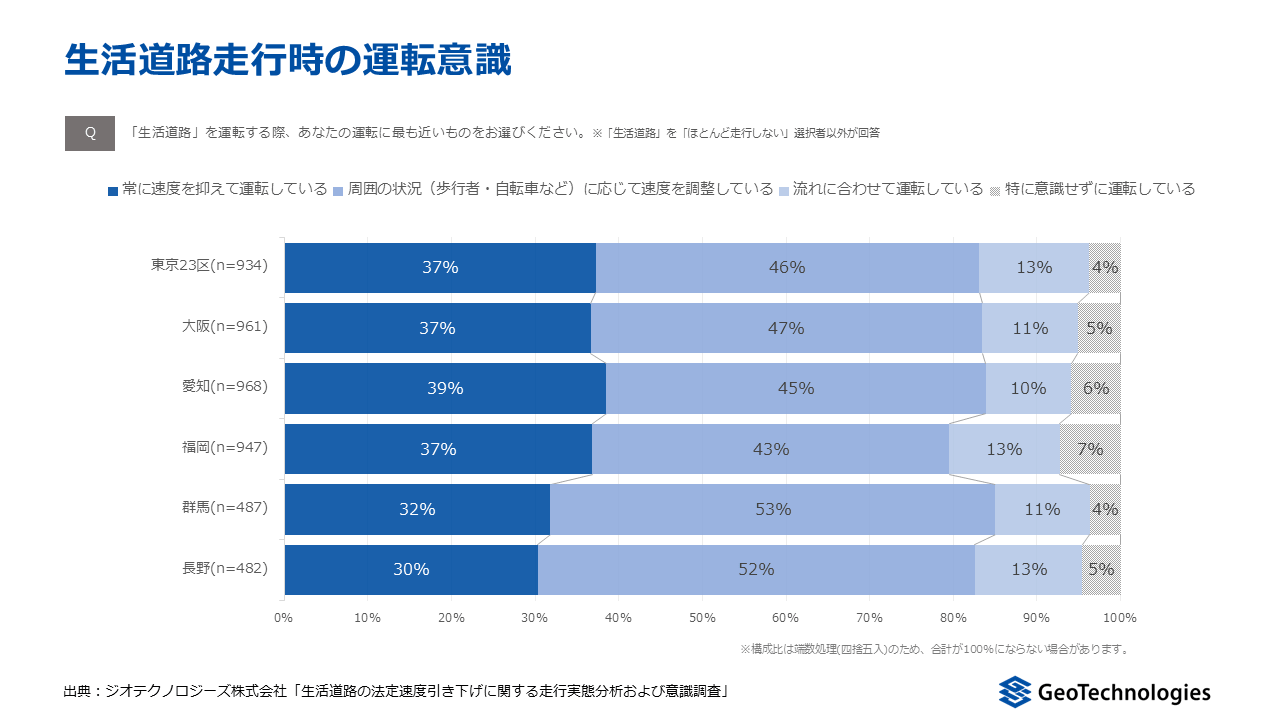
<9. Driving awareness when driving on residential roads: Approximately 80% are safety-conscious regardless of region>
Regarding driving awareness when driving on residential streets, approximately 80% of respondents in all regions answered that they "always drive at a reduced speed" or "adjust their speed according to the surrounding conditions (pedestrians, cyclists, etc.)," indicating that they are mindful of safe driving.
Looking at the details, the percentage of people who answered that they "always drive at a reduced speed" was slightly lower in Gunma and Nagano prefectures than in urban areas, but there was no significant difference.
Furthermore, in all regions, the most common response was "adjusting speed according to surrounding conditions," accounting for 40-50% of respondents. On the other hand, nearly 20% of respondents answered that they "drive in accordance with the flow of traffic" or "drive without particularly thinking about it."
<10. Dangerous experiences on local roads: Over 90% have experienced danger; "sudden darting out" is the most common in urban areas, while "oncoming vehicles" is the most common in rural areas.>
Regarding experiences of feeling unsafe on residential streets, approximately 50% of drivers in all regions cited "close proximity to pedestrians and cyclists." Furthermore, only about 5% of respondents in every region answered that they "have never felt particularly unsafe," suggesting that most drivers have experienced some form of danger on residential streets.
Looking at the results by region, 55% of respondents in Tokyo's 23 wards cited "bicycles suddenly darting out," compared to 36% in Nagano Prefecture, showing a significant difference of approximately 20 percentage points. In addition, in Gunma and Nagano prefectures, the percentage of people who cited "passing oncoming vehicles" exceeded 50%, showing a slightly higher tendency than in urban areas.
Furthermore, in Tokyo's 23 wards, over 30% of respondents felt that riding electric scooters was dangerous, a result significantly higher than in other areas.

<11. Expectations and challenges revealed from open-ended responses: While there are expectations for a reduction in accidents, there are also concerns about being "incited to panic" and calls for greater awareness.>
In the open-ended responses (1,674 valid responses) regarding the reduction of the legal speed limit on residential roads, many expressed positive expectations for the system's introduction, such as "a decrease in accidents" and "improved safety." On the other hand, concerns such as "I might be tailgated," "I'm worried about pressure from the car behind me," and "I might get honked at" were mentioned by about 10% of the responses.
In addition to comments pointing out the lack of clarity regarding the target roads and rules, there were also calls for improved safety measures, including for pedestrians and cyclists, as well as increased awareness and information provision about the system.
*The number of valid responses (1,674) and the mention rate (approximately 10%) are approximate values calculated by machine extraction using relevant keywords from open-ended response data, with some manual verification.
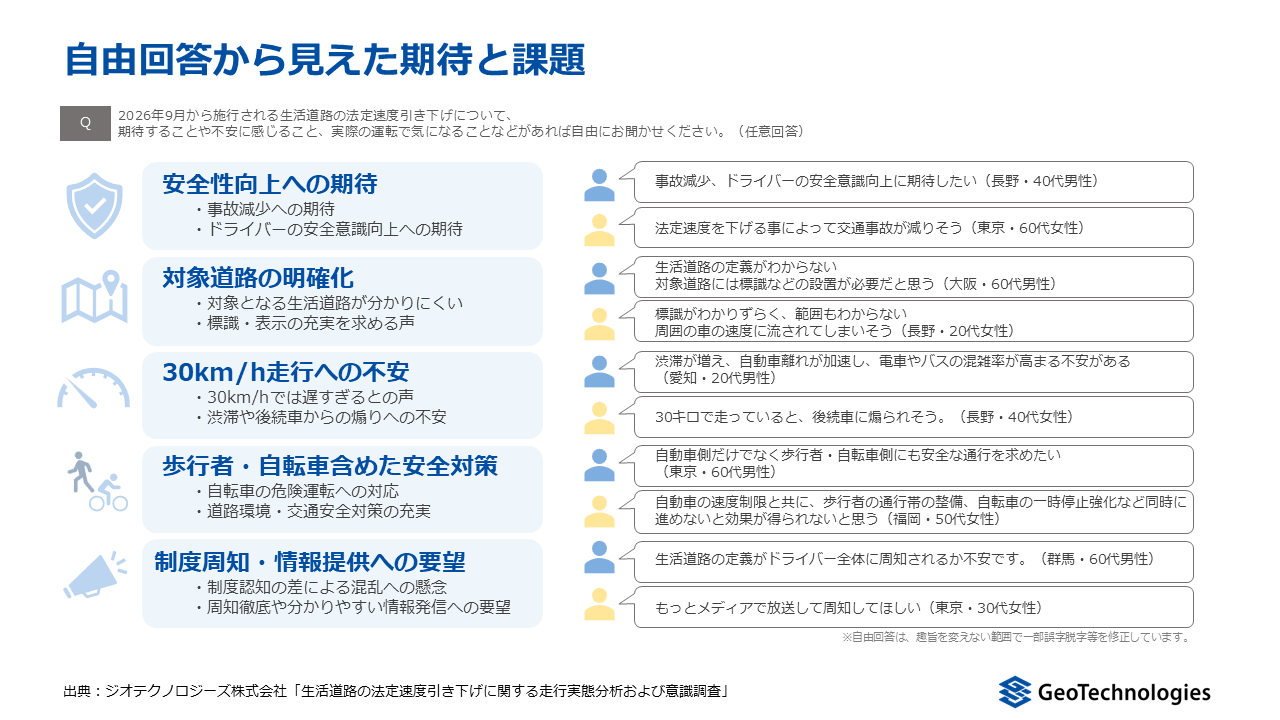
[Overall Analysis] Challenges and Prospects for Establishing a 30km/h Speed Limit Based on Analysis of Actual Driving Practices and Awareness Surveys
This survey was conducted using two approaches: "analysis of actual driving conditions" based on people flow data and "a survey of drivers' attitudes." By analyzing both sets of data from multiple perspectives, we were able to gain insights into drivers' understanding of the 30 km/h speed limit on residential roads in September 2026, the current state of driving, and future challenges.
The gap between awareness of safety considerations and the speed limit after the reduction.
This survey reveals that the proposed reduction in the legal speed limit on residential roads in September 2026 is considered a "necessary revision" by approximately 90% of drivers, indicating widespread support. Furthermore, about 80% of respondents said they "always keep their speed down or adjust it according to their surroundings" when driving on residential roads, suggesting that they are taking certain safety precautions.
However, looking at actual driving conditions, under the current legal speed limit (60 km/h), approximately 60% to 90% of vehicles in all areas except Tokyo's 23 wards are driving at speeds "over 30 km/h." While this is within the appropriate range under the current rules, if drivers continue to drive with the same sense of normalcy while maintaining a sense of "safety," there is a possibility that a gap will arise after the new legal speed limit (30 km/h) comes into effect in September, causing them to exceed that limit.
The reality of "Zone 30" and the challenges revealed by awareness surveys.
Even in "Zone 30" areas where a 30 km/h speed limit has already been implemented, the proportion of vehicles exceeding 30 km/h is approximately 50-60% in urban areas such as Tokyo's 23 wards, Osaka Prefecture, Aichi Prefecture, and Fukuoka Prefecture. Furthermore, in rural areas (Gunma Prefecture and Nagano Prefecture), the proportion of vehicles exceeding 30 km/h reaches approximately 70-80%, indicating that it has become commonplace.
When this situation is combined with the results of the awareness survey (correct answer rate less than 10% / difficulty in identifying the target roads / pressure from following vehicles about 30%), it is suggested that simply "restricting speed to 30 km/h" may not be sufficient to reduce speed effectively. To ensure compliance, it is important to clearly communicate the target roads, address pressure from surrounding vehicles, and consider road structures that tend to encourage high speeds. Furthermore, conducting awareness campaigns tailored to local driving conditions is also expected to promote compliance with the law.
In conclusion
The environment surrounding transportation is facing challenges such as an aging population, depopulation, and chronic traffic congestion, which necessitate addressing a variety of social issues, including the promotion of safety measures.
Amidst this environment, GeoTechnologies, Inc. has been providing digital map data for car navigation systems for 30 years since its founding, supporting people's mobility. In addition to the knowledge and technology cultivated over many years in the transportation field, the company is working to solve social issues by making full use of its geospatial data and dynamic data, including people flow data.
We hope that the results of this survey, conducted as part of these efforts, will be utilized in future awareness campaigns, improvements to the traffic environment, and other initiatives that contribute to local traffic safety.
Furthermore, using this pre-implementation survey as a baseline, we plan to conduct further analyses of driving behavior and awareness surveys after the implementation date of September 1, 2026, to track and verify changes before and after the reduction of the legal speed limit.
Survey Overview
< Summary of driver awareness survey based on questionnaire research >
Survey Objective: To understand the actual usage of local roads and the level of awareness and understanding of the system prior to the reduction of the legal speed limit on local roads, and to identify challenges in ensuring compliance.
Research methodology: "Geo-Research" (Web survey of users of the point-earning app "Torima")
Eligibility: Men and women aged 20-69, holding a regular driver's license and driving at least once a month, and residing in the target area (as of June 1, 2026).
Target areas: Tokyo's 23 wards, Osaka Prefecture, Aichi Prefecture, Fukuoka Prefecture, Gunma Prefecture, Nagano Prefecture
Survey sample size: 4,994
Allocation: Equal distribution by gender and age group (best effort)
Survey period: Tuesday, June 23, 2026 - Monday, June 29, 2026
< Outline of analysis of actual running conditions based on people flow data >
Research Objective: To understand and compare the actual driving speeds on "residential roads" and "Zone 30" areas, as well as regional driving characteristics, and to identify challenges for compliance.
Research Methodology: "Geo-People" (Analysis of vehicle driving history extracted from people flow data of users of the point-earning app "Torima")
Target areas: "Zone 30 designated areas" and "local roads (5 locations)" in Tokyo's 23 wards, Osaka Prefecture, Aichi Prefecture, Fukuoka Prefecture, Gunma Prefecture, and Nagano Prefecture.
Survey period: Friday, May 1st, 2026 to Sunday, May 31st, 2026
Inquiries regarding services for corporate clients
For inquiries, please click here.

Related articles
-
 2020.05.29Introduction to Digital Maps
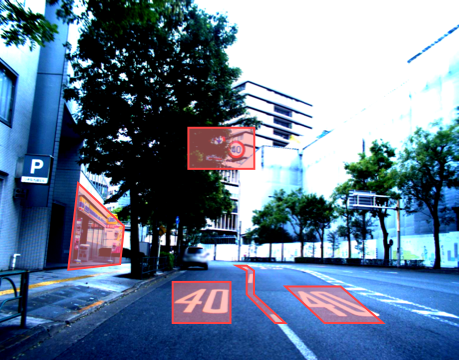
What are "road driving images"? —Driving images from GeoTechnologies, Inc. that record all roads nationwide.
-
 2024.01.24Introduction to Digital Maps
What are those small numbered Distance post along the highways? GeoTechnologies, Inc. which possesses Distance post data, explains how to use them effectively.
-
 2020.06.30Introduction to Digital Maps
Digital maps are also protected by copyright! You might be using them without permission without realizing it. Printing or reusing digital maps requires permission from the map-making company.
