


What will autonomous driving (AD) bring to smart cities?



The other day, I saw a notice at a bus stop near my company saying that there would be fewer bus services due to a shortage of drivers.
"I never thought it would happen in Tokyo..." That was the moment I truly felt the current situation where maintaining local transportation is becoming increasingly difficult. The "transportation challenges" currently faced by communities throughout Japan are no longer something that can be ignored.
This time, we will explain in detail the smart city concept promoted by the government and the effects that autonomous driving, which is key to it, will bring. In addition, we will introduce the autonomous driving support data provided by GeoTechnologies, Inc. and specific initiatives to address the challenges.
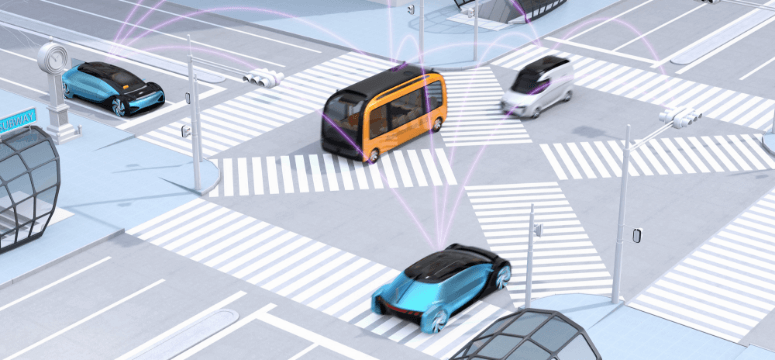
Current mobility challenges in the region
Regional public transportation in Japan faces serious challenges due to structural changes caused by a declining birthrate, an aging population, and overall population decrease. While the population and ridership continue to decline, there is a growing demand from local residents for the maintenance and improvement of public transportation, raising renewed questions about the role of transportation services.
The figures regarding the current state of local public transportation and local demands in this article are based on data published by the Ministry of Land, Infrastructure, Transport and Tourism.
Reference material: Ministry of Land, Infrastructure, Transport and Tourism, Current Status of Regional Transportation https://www.mlit.go.jp/policy/shingikai/content/001898150.pdf
<Current state of local public transportation>
1. Long-term decline in the number of local public transport users
In Japan as a whole, the total population peaked in 2008 and has been declining ever since, with estimates projecting it to shrink to approximately 120.11 million by 2030 and approximately 112.84 million by 2040. Along with this population decline, the number of public transportation users is also showing a long-term downward trend.
Furthermore, the number of users of local public transportation has plummeted due to the stay-at-home orders imposed as a result of the COVID-19 pandemic, and has not yet returned to previous levels. This decline in users is common to many transportation services, including buses, taxis, and railways, with the drop being particularly pronounced in rural areas.
2. A serious structural problem: a shortage of drivers.
Securing personnel to support local public transportation is also a major challenge. Labor supply and demand simulations predict a shortage of approximately 379,000 workers in the transportation, machine operation, and logistics industries (i.e., bus and taxi drivers) by 2030, and a shortage of approximately 998,000 workers by 2040. This is an extremely high shortage rate compared to all industries, indicating that securing drivers will become difficult.
Furthermore, statistics show that the job-to-applicant ratio for these occupations is higher than in other industries, indicating a continuing shortage of drivers. A high job-to-applicant ratio means that there are fewer job seekers than available positions, confirming that local public transport operators are struggling to secure personnel.
3. The reality of reduced bus routes and declining service.
Declining ridership and labor shortages are leading to a decline in local public transportation services. In rural areas in particular, bus routes are being reduced or discontinued, resulting in the loss of essential means of transportation for daily life. The disappearance of transportation services from residents' living areas is making it increasingly difficult for them to travel to hospitals, schools, and shops.
<Local requests>
Against this backdrop, the following specific requests have been received from the community:
1. Ensuring transportation for the elderly
As the population ages, more and more people are voluntarily surrendering their driver's licenses. In fiscal year 2019, more than 600,000 licenses were surrendered nationwide, highlighting the growing need for elderly people to secure means of transportation within their living areas.
There is a strong demand for improved local public transportation so that elderly people who can no longer rely on cars after surrendering their driver's licenses do not lose their means of transportation for shopping, going to medical appointments, and socializing with friends and acquaintances.
2. Maintaining access to healthcare facilities and schools.
In rural areas, there is a growing concern that hospitals and schools will be consolidated or closed, making it difficult for local residents to secure transportation to these facilities. Local residents have made strong requests to maintain transportation options so that they can continue to go to hospitals and schools.
Addressing local transportation challenges: Public ride-sharing
One initiative to address local transportation challenges is public ride-sharing.
Public ride-sharing (private paid passenger transport) is a system established in 2006, operated primarily by municipalities and other local governments, with the aim of securing transportation options in areas with poor public transport, such as those lacking public transportation. In recent years, it has been attracting renewed attention as a means of supplementing local transportation, against the backdrop of a shortage of taxi drivers and a declining population.
Between the end of2023 and 2024, the governmentrevised the system, making it possible to use the service during hours when taxis are not operating, and raising the fare cap. As a result, the number of municipalities that have adopted the system has increased dramatically,reaching645 municipalities as of March 2024, representingapproximately37%ofthe entire country.
On the other hand, although the introduction of these services appears to be progressing, there are many areas where they are not adequately supporting residents' daily transportation needs due to reasons such as limited operating hours and days, and difficulties in securing drivers. The burden on local governments is also significant, and the reality is that simply introducing the system does not solve the fundamental problems of local transportation.
Going forward, instead of evaluating public ride-sharing services solely on the number of introductions, it is necessary to consider how effectively they support local transportation and to implement initiatives that combine them with other transportation policies.
In Japan, there are two types of ride-sharing: public ride-sharing and a Japanese version of ride-sharing that complements the shortage of taxis.For more information about ride-sharing, please see this article.
Smart City Concept
A smart city is a concept for creating sustainable and comfortable cities that utilizes advanced technologies such as ICT (Information and Communication Technology) and AI to address transportation challenges such as reducing congestion and improving safety through the visualization and optimal control of traffic data, while also aiming to solve social issues such as environmental issues, disaster prevention, and aging populations.
A smart city refers to a city that utilizes information and communication technology and data to improve the efficiency of urban management and enhance the quality of life for its residents. Autonomous driving is one of the core technologies supporting its realization. The use of autonomous vehicles is expected to optimize traffic flow and reduce accident risks, as well as improve the efficiency of transportation through coordination with public transport and ensure transportation options for diverse people, including the elderly. Advances in autonomous driving technology will strongly support the realization of smart cities by building safe and sustainable transportation systems. GeoTechnologies, Inc. is currently developing MapFan ADAS, whichis more detailed map data thanSD maps that can be used withADAS. If you are interested in howMapFan ADAS can help reduce traffic accidents, please see this document.
What is autonomous driving (AD)?
Classification of autonomous driving levels
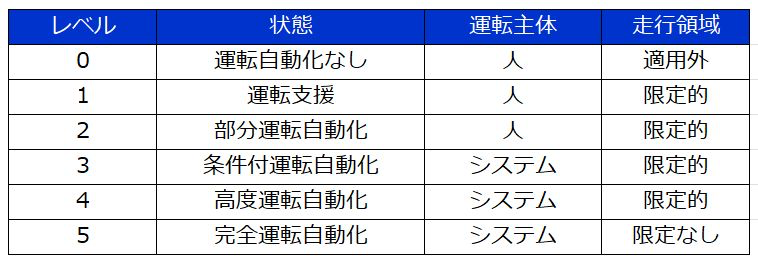
Currently, autonomous driving technology is classified into six levels, from "Level 0" to "Level 5," depending on the features it includes and the degree of human involvement. This classification is an international standard that indicates the extent to which the vehicle is responsible for driving operations.
The difference between autonomous driving (AD) and advanced driver-assistance systems (ADAS)
When an autonomous vehicle is involved in an accident, "who is responsible?" is a crucial question. This responsibility is clearly defined at the boundary between Level 2 and Level 3 autonomous driving.
Up to Level2, the system is classified as "driving assistance," and the driver remains the primary driver. Therefore, the driver is responsible in the event of an accident.
On the other hand, at Level 3 and above, the vehicle is treated as "autonomous driving" where the vehicle takes the lead in driving, and under certain conditions, responsibility in the event of an accident is shifted to the vehicle.
The reality is that "Level 2 enhancement" is the mainstream.
Currently, most vehicles sold in Japan are equipped withdriver assistance technologies up to Level 2, or ADAS. These technologies provide functions to assist with acceleration, deceleration, and steering, but their role is ultimately limited to supporting the driver's driving.
Therefore, with current ADAS systems, the ultimate responsibility in the event of an accident lies with the driver, and it cannot be said to be fully autonomous driving. At Level3, the vehicle takes the lead in driving, meaning that if an accident occurs, the vehicle will be held responsible. If the vehicle is held responsible for the accident, the company that provides the autonomous vehicle may also have to bear responsibility.Against this backdrop, manufacturersare currently working on "level 2enhancements (Level2+)" as a preliminary step before reaching Level 3.
Many challenges exist for Level 3 and above autonomous driving, including technical aspects, legal frameworks, and social acceptance. Nevertheless, governments and automakers are working to overcome these challenges while continuing development toward the realization of more advanced autonomous driving.
The relationship between autonomous driving and maps
Regarding the relationship between autonomous driving and maps, there was a time when it was believed that "maps are not necessarily required." However, nowadays, the understanding is shifting towards the idea that maps are indispensable as a means of understanding in advance traffic lights that cannot be recognized byLiDAR or cameras due to obstructions, and complex branching structures in the direction of travel.
Furthermore, processing the vast amount of information acquired fromLiDAR and cameras from scratch places a heavy burden on computation. Therefore, the current mainstream approach in autonomous driving systems is to use maps as prior information to streamline recognition and decision-making, thereby reducing the computational load.
Simulation is essential GeoTechnologies, Inc.AD/ADAS development. Geotechnologies people flowOpenDRIVE format map data and pedestrian flow data that can be used for simulations. If you are interested in OpenDRIVE format data,please check this document.
Examples of autonomous driving initiatives in public transportation
<Example of a Smart City Pilot Project in Moroyama Town>
In Moroyama Town, in order to ensure the sustainable provision of administrative services and improve the quality of life even in an era of population decline, we are actively introducing advanced technologies, including ICT technologies, into existing industries and public services.
This plan aims to implement autonomous buses in society, support agriculture using autonomous drones, promote digital government, and foster the concentration of new industries through technological advancements in existing industries. In particular, autonomous buses are planned to operate as a means of transportation connecting new towns lacking public transport with the nearest train stations.
Prior to this, in December 2019, we began a demonstration experiment of a bus location system utilizing LPWA (Low Power Wide Area) communication, and in March 2020, we conducted a demonstration run with an 11-seater autonomous bus. We are continuing to verify the system's practical application by running on public roads for approximately 2.6 kilometers round trip.
<Reference>
https://www.mlit.go.jp/scpf/projects/docs/smartcityproject_mlit(1)%2005_moroyama.pdf
Toyota Motor Corporation 's InitiativesforWoven City>
Woven City, which is being developed as a testing ground, will be used to verify various new technologies, with the participation of the people who will actually live there.
① Three types of ground roads
The ground-level roads in Woven City are designed in three distinct sections, each serving a different purpose.
The first is a "pedestrian-only path" where only people can walk safely.
The second is a "coexistence road" where electric wheelchairs and small electric mobility devices travel alongside people at roughly the same speed.
The third typeis a "mobility-only road" where only autonomous vehicles, such as the self-driving EV"e-Palette," can travel.
These represent a new road design that differs from the traditional concept of separating sidewalks and roadways, and is tailored to future modes of transportation.
② Verification of new services utilizing the autonomous EV e-Palette
The autonomous electricvehicle"e-Palette" will be operated as a public transport (minibus) in Woven City, an experimental city with roads close to public roads, to conduct full-scale autonomous driving demonstration tests. This is expected to be a step up in autonomous driving technology. For more details, please refer to the section on Woven City's autonomous bus initiative below.
Furthermore, the multi-purpose autonomous electric vehicle "e-Palette" will be used not only for transportation but also for demonstrations as a "mobile service hub" providing food, beverages, and entertainment. In fact, at a press preview, the e-Palette was used as a food truck to serve coffee. It is expected to be used in a variety of situations in the future.
③ Underground passage
Woven City will feature not only above-ground infrastructure but also an "underground network." This network is designed to conduct demonstrations in an environment less affected by weather and temperature, and it connects to all the buildings in the first phase area. Logistics robots are envisioned to travel along the approximately 400-meter-long underground passages, automatically delivering mail and packages to each household.
④ How signals work
We also plan to introduce a system that automatically adjusts traffic light switching in conjunction with autonomous vehicles. The goal is to create an environment where both pedestrians and vehicles can move safely and smoothly, for example, by changing the traffic light to green when a car approaches.
⑤ Multifunctional pole
In addition to their roles as streetlights and traffic signal poles, multi-functional poles that can be fitted with sensors and cameras will be installed and used for demonstrations to understand the state of the city. It is also expected that the information obtained from these multi-purpose poles will be shared with autonomous vehicles to improve the accuracy of safety measures.
⑥ Demonstration of new mobility and robots
We also plan to test shared electric small mobility services and automated car transport using robots. Furthermore, we have decided to introduce "cocomo," a robot based on the concept of "a robot that is close to people," and we are looking forward to seeing how robots will play an active role in supporting our daily lives.
Reference: Toyota Motor Corporation
Woven City's autonomous bus initiative
Toyota's multi-purpose electric vehicle, the "e-Palette," is used for transportation within Woven City. While it is normally driven manually by a driver when carrying residents, separate demonstration experiments on autonomous driving are also underway.
Experiments are underway on city streets where e-Palette and traffic lights exchange information, testing a system that flexibly controls traffic signals in response to approaching vehicles and pedestrian conditions. The aim is to ensure safe travel while smoothing the flow of traffic.
These traffic lights are integrated into multi-functional poles equipped with sensors and cameras, and are installed in various locations throughout the city. In the future, they are expected to be used not only for autonomous driving but also for testing new transportation infrastructure and urban functions, with continuous demonstrations being conducted while changing the settings.
Woven City is accumulating knowledge for the realization of future smart cities by verifying mechanisms in which mobility and infrastructure are linked within a real city.
<Reference> TOYOTA WOVEN CITY Toyota e-Palette
With the decline in population, lifestyles are changing dramatically in each region, and the impact on public transportation, in particular, is becoming apparent. In order for people in these regions to continue to move around smoothly, the introduction of new technologies in addition to existing systems is essential. One solution that is attracting attention is autonomous driving.
If autonomous driving technology is introduced to buses and taxis, creating an environment where people can move freely, it is expected to improve convenience for residents, facilitate travel in tourist areas, and revitalize local economies.
These challenges are not limited to sparsely populated areas; driver shortages are a serious problem in urban areas such as Tokyo and Kanagawa. As part of countermeasures, Tokyohas announced the start of a Level 2 autonomous driving demonstration experiment, and expectations for autonomous driving are rising nationwide.
GeoTechnologies, Inc.developsMapFan ADAS, a map data set that can be used for autonomous driving (AD/ADAS). If you are interested inMapFan ADAS, please contact us.
Inquiries regarding services for corporate clients
For inquiries, please click here.

Related articles
-
 2020.06.30Introduction to Digital Maps
Digital maps are also protected by copyright! You might be using them without permission without realizing it. Printing or reusing digital maps requires permission from the map-making company.
-
 2026.05.26Introduction to Digital Maps
The new Logistics Efficiency Law will finally come into effect in April 2026! We'll provide a detailed and easy-to-understand overview of its contents and solutions using maps and people flow data!
-
 2024.03.25Introduction to Digital Maps
What are the benefits of implementing dynamic management? GeoTechnologies, Inc. which possesses nationwide map data and people flow data, will explain in detail.
