


Investigating the Differences Between Japanese and Foreign Tourists in Kyoto Using people flow Data: Arashiyama and Kiyomizu, Popular with Foreign Tourists, and Shijo Street, Where Both Tourism and Local Life Concentrate.



GeoTechnologies, Inc. conducted a survey using people flow data to investigate popular areas and itineraries among tourists visiting Kyoto, focusing primarily on the similarities and differences between Japanese and foreign visitors.
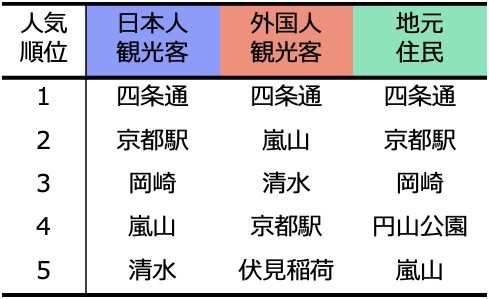
The key points revealed in this survey and the popularity ranking of tourist areas (Table 1) are shown below. Further details will be explained in the following sections.
- The Shijo Street area is the most visited by both tourists and local residents.
- The Okazaki area is popular with Japanese tourists, while the Arashiyama and Kiyomizu areas are popular with foreign tourists.
- For tourists, the central areas are the Kyoto Station area and the Shijo-dori area for Japanese people, and the central areas for foreigners are the Arashiyama area, the Kiyomizu area, and the Shijo-dori area.
- Foreign tourists are also keen to travel relatively long distances, such as traversing Kyoto from Arashiyama to Kiyomizu.
GeoTechnologies, Inc. provides consulting and contract analysis services based on advanced people flow analysis technology. If you are interested, please feel free to contact us using this inquiry form.
Survey Overview
In recent years, inbound tourism and the resulting overtourism have been hot topics in Japan, with the number of foreign visitors to Japan reaching a record high in 2025 *1. Although the number of visitors is expected to decrease in 2026, spending is projected to continue increasing *2, making it a topic that remains highly noteworthy. Therefore, focusing on Kyoto in the spring, which is likely to be the center of such discussions again this year, we investigated the similarities and differences between Japanese and foreign tourists in their travel behavior by analyzing people flow data.
GeoTechnologies, Inc. operates the M2E (Move to Earn) app "Torima," and utilizes people flow data collected by Torima for various business operations while respecting privacy. This survey uses human flow data of app users who visited Kyoto City from April 1st to April 30th, 2025 (30 days), and when this is visualized on a map, it looks like Figure 1 on the left. In addition to Torima data, this study also utilized people flow people flow of foreign visitors to Japan *3, using people flow data for over 190,000 people in total.
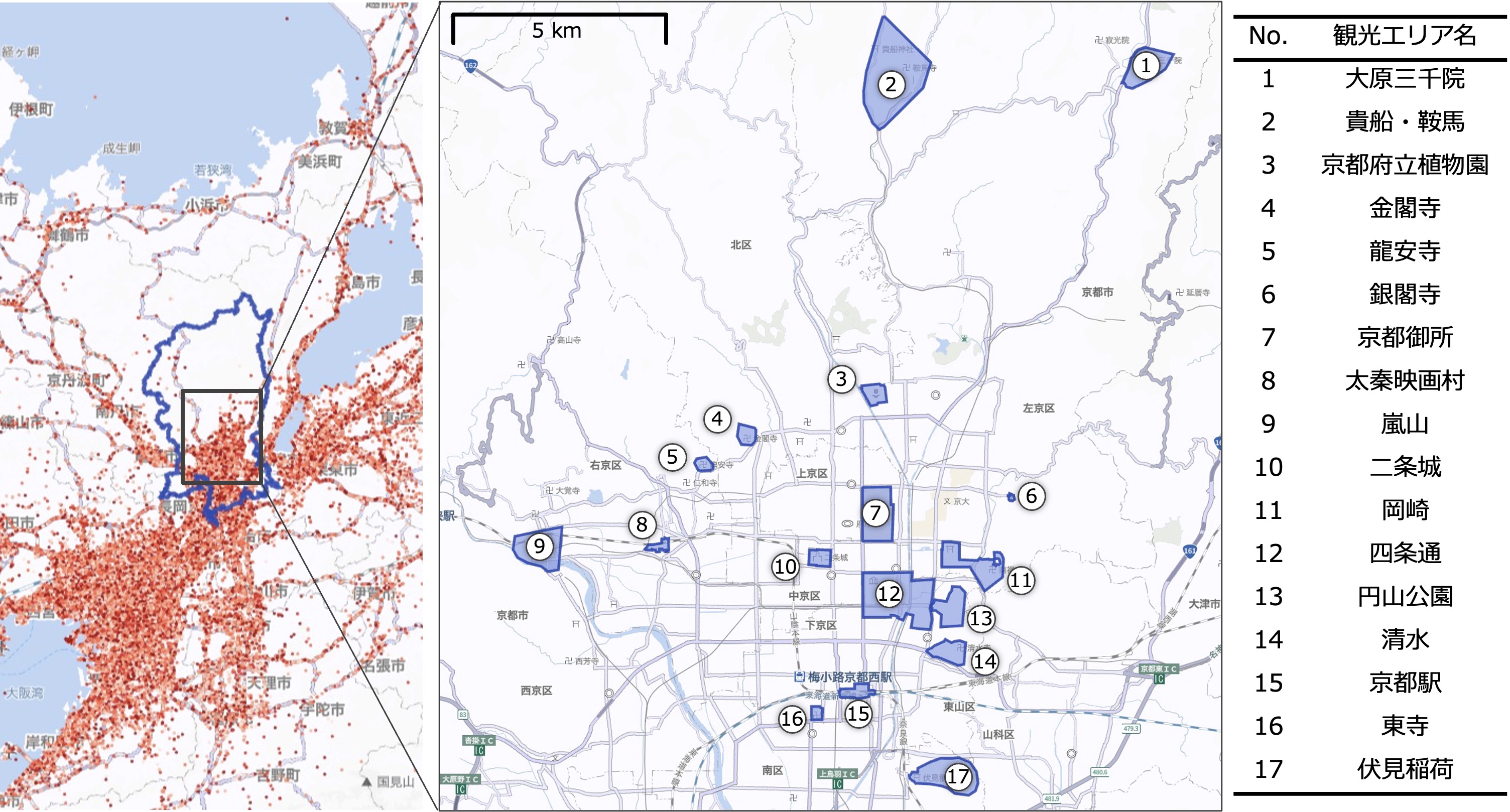 Figure 1: people flow in Kyoto City (left) and tourist areas (right)
Furthermore, this survey targeted 17 tourist areas within Kyoto City (Figure 1, right). Tourist areas include those consisting of a single tourist attraction, such as the Kinkaku-ji Temple area, and those grouping together several nearby tourist attractions, such as the Ohara Sanzen-in Temple area. To elaborate on some of the areas grouped together, the Okazaki area includes Heian Shrine, Nanzen-ji Temple, as well as art museums, a zoo, and a baseball stadium. The Shijo-dori area is a bustling commercial district centered around Shijo Kawaramachi, extending from Karasuma-dori to Gion. The Maruyama Park area is a temple and shrine area including Yasaka Shrine, Chion-in Temple, and Kodai-ji Temple. The Kiyomizu area includes Kiyomizu-dera Temple and the slope leading up to it lined with souvenir shops.
- *1: Japan Tourism Agency, Ministry of Land, Infrastructure, Transport and Tourism, Number of Foreign Visitors to Japan and Number of Japanese Departures, https://www.mlit.go.jp/kankocho/tokei_hakusyo/shutsunyukokushasu.html
- *2: JTB Research Institute, Inc., Forecast of Inbound Travel Market Trends for 2026 (January-December), https://www.tourism.jp/news/2026/01/2026-inbound-outlook/
- *3: Azira, Pinnacle Data Sets, https://azira.com
What are the most popular tourist areas?
First, we will examine how visitor trends in tourist areas differ between Japanese and foreign tourists, comparing them with those of local residents. Figure 2 shows the visitor rates to tourist areas in April 2025. For example, Shijo Street is visited by approximately 40% of Japanese tourists, meaning it is the most popular area for Japanese tourists.
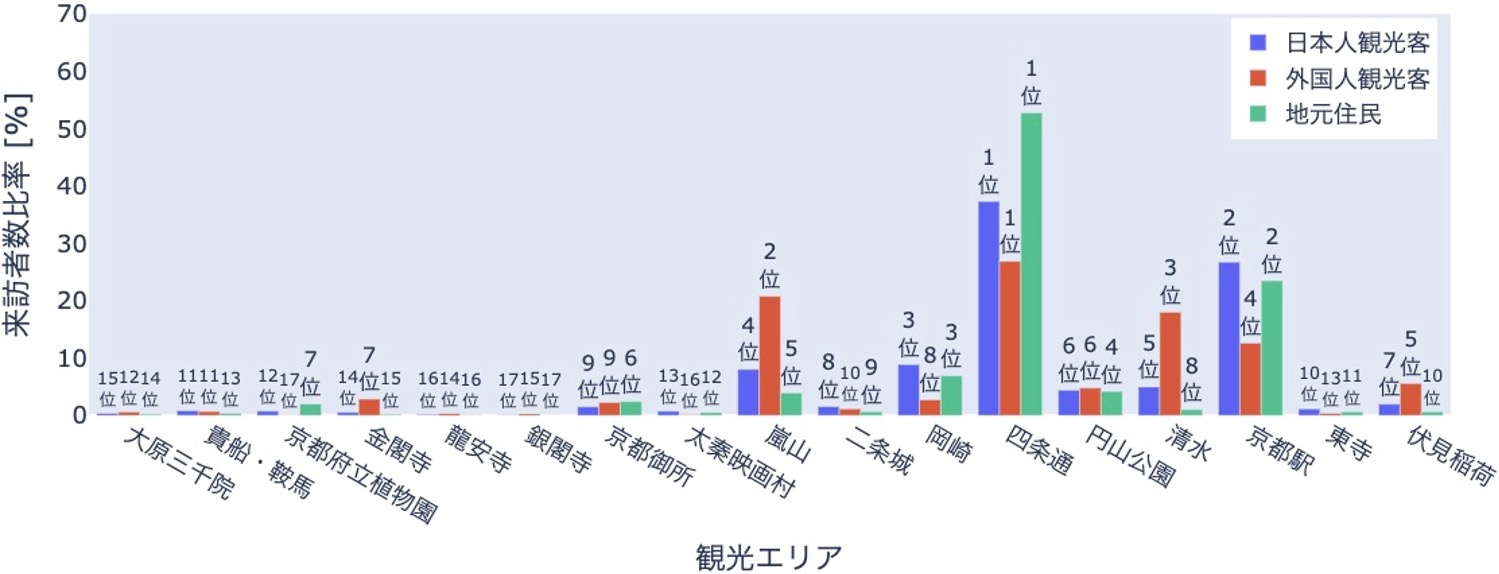 Figure 2: Visitor rate in tourist areas
As the diagram shows, Shijo Street is an area visited by many people, regardless of their nationality as tourists or whether they are local residents. Areas with such characteristics are prone to overtourism problems. In fact, Shijo Street is located in the heart of Kyoto and is an area where facilities for various purposes such as shopping, dining, entertainment, and accommodation are concentrated, so it is crowded with many people on a daily basis, and the worsening of overtourism is being discussed. *4 Similarly, Kyoto Station, a transportation hub, also receives many visitors regardless of their nationality or whether they are tourists.
Focusing on the differences, Arashiyama and Kiyomizu rank second and third in terms of visitor rates among foreign tourists, but their visitor rates among Japanese tourists and local residents are somewhat lower, making them particularly popular areas for foreigners. On the other hand, the Okazaki area has a lower visitor rate among foreign tourists but a higher visitor rate among Japanese tourists and local residents, so Heian Shrine, Nanzenji Temple, art museums, and zoos in this area are popular with Japanese tourists and local residents. In addition, it was found that Fushimi Inari Shrine and Kinkakuji Temple are particularly popular with foreign tourists, while the Kyoto Prefectural Botanical Garden is popular with local residents.
- *4: Kyoto City Industrial Tourism Bureau, Results of the 2024 Kyoto Tourism Comprehensive Survey, https://www.city.kyoto.lg.jp/sankan/page/0000341863.html
Which tourist area should we go to next?
Next, we will look at the differences between Japanese and foreign tourists in terms of movement between tourist areas. Figure 3 shows a heatmap of the movement rates, indicating which area tourists are most likely to move to after visiting a particular tourist area on the same day. Here, darker colors indicate a higher likelihood of movement. For example, the first row on the far left of the figure shows that Japanese tourists often move to Shijo Street, Kyoto Station, or the Kibune/Kurama area after visiting Ohara Sanzen-in Temple. However, movement returning to the same area within one hour is excluded.
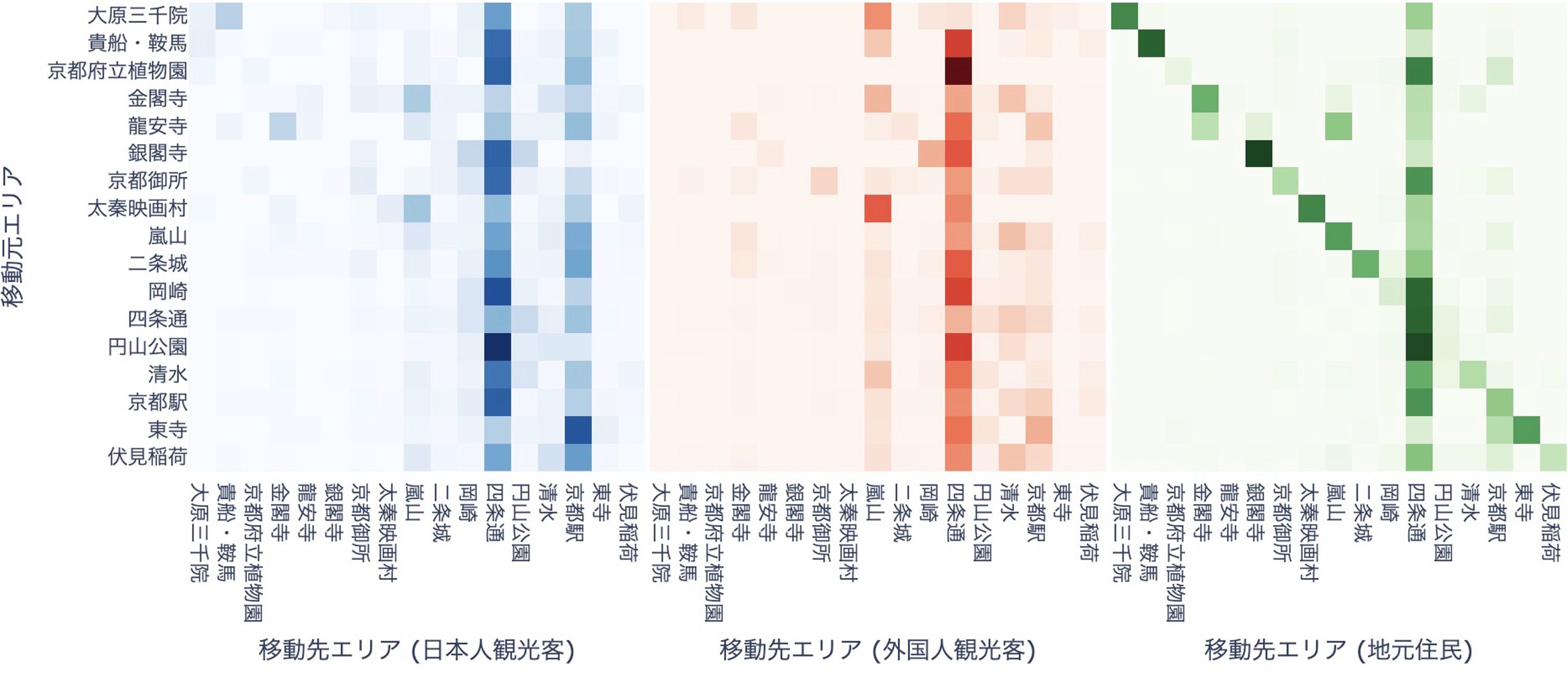 Figure 3: Movement rate between tourist areas
A notable finding is that both Japanese and foreign tourists, as well as locals, frequently travel to Shijo Street. This aligns with the previously mentioned high visitor rate to Shijo Street, suggesting that many people dine or stay overnight there after sightseeing elsewhere. Focusing on Japanese tourists, Kyoto Station is also a frequent destination, a characteristic not as pronounced among foreign tourists. This suggests that Japanese tourists tend to take day trips more often than foreign tourists, and that they frequently return home from Kyoto Station by Shinkansen or other means after sightseeing. Local residents, in addition to traveling to Shijo Street, frequently return to the same locations. This could indicate that they are employees.
Focusing on the subtle differences between Japanese and foreign tourists, we see that while Japanese tourists often travel from Ohara Sanzen-in Temple to Kibune and Kurama, foreign tourists tend to head towards Arashiyama. Kibune and Kurama are relatively close to Ohara Sanzen-in Temple (approximately 6.0 km in a straight line), so the movement of Japanese tourists to these locations seems natural. On the other hand, Arashiyama is about 18.3 km away, suggesting that the Ohara Sanzen-in → Arashiyama sightseeing route may hold a special appeal for foreign tourists.
Let's take a closer look at the distances traveled between tourist areas. Figure 4 shows the top 15 most frequent types of travel between tourist areas, along with the distances between them. For example, looking at the left edge of the figure, we can see that the most common travel route for Japanese tourists between tourist areas is Shijo-dori to Shijo-dori, accounting for about 10% of the total. The distance between areas for this return trip is 0 km. For Arashiyama to Shijo-dori, the distance between areas is approximately 8.5 km, accounting for about 3.2% of the travel by Japanese tourists.
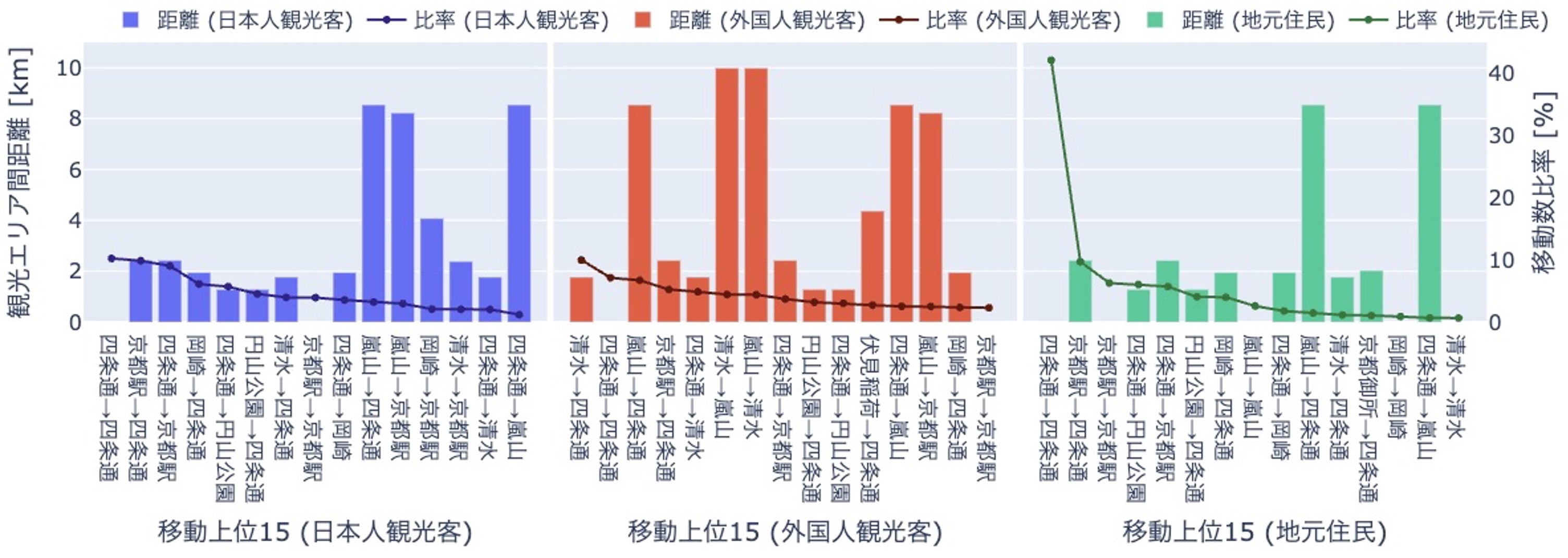 Figure 4: Movement between tourist areas and distance between areas
Earlier, we found that foreign tourists traveled a longer distance between areas, such as from Ohara Sanzen-in Temple to Arashiyama, more frequently than Japanese tourists. While this particular long-distance travel accounted for only about 0.3% of foreign tourists' trips (ranking 47th), the overall trend shows that trips exceeding 5km, such as Arashiyama to Shijo-dori and Kiyomizu-dera to Arashiyama, ranked higher. This trend is not seen among Japanese tourists or local residents. Calculating the average distance between areas from all inter-area travel, foreign tourists averaged approximately 4.3km, Japanese tourists approximately 2.9km, and local residents approximately 1.2km. This strongly suggests that foreign tourists are less resistant to relatively long-distance travel between tourist areas.
In addition, we found that many people, regardless of nationality or whether they are tourists, travel from Shijo Street to areas outside the tourist zone we focused on, and then return to Shijo Street.
How should I tour the tourist area?
We will observe the movement between tourist areas for a longer period and examine how tourists tour these areas. Figure 5 shows the order in which Japanese tourists visited tourist areas in a single day. From the figure, for example, we can see that the most common destination for Japanese tourists was Shijo Street, and then a large number of them went to Kyoto Station, from where a small number returned to Shijo Street (1: Shijo Street → 2: Kyoto Station → 3: Shijo Street). This represents a popular route. Similarly, Figure 6 shows the data for foreign tourists. However, in both cases, only the top 10% with the highest number of visits are shown, and the percentage of movement between some areas relative to the total is also shown.
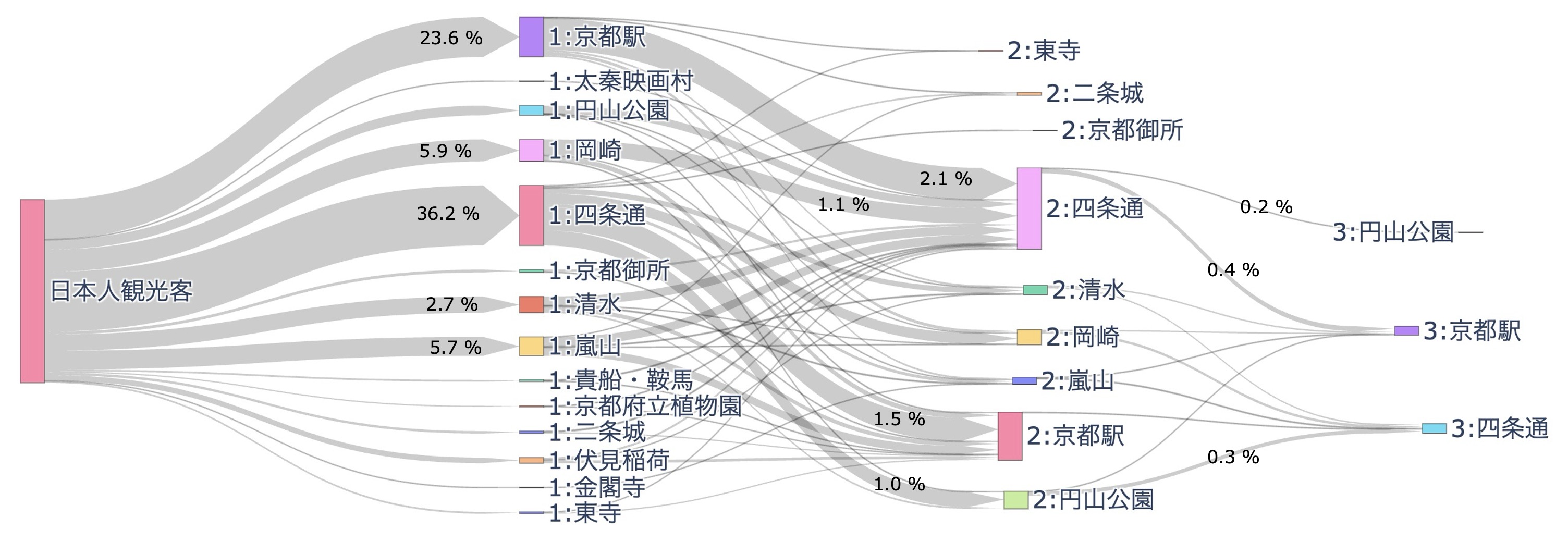 Figure 5: Tour of tourist areas by Japanese tourists
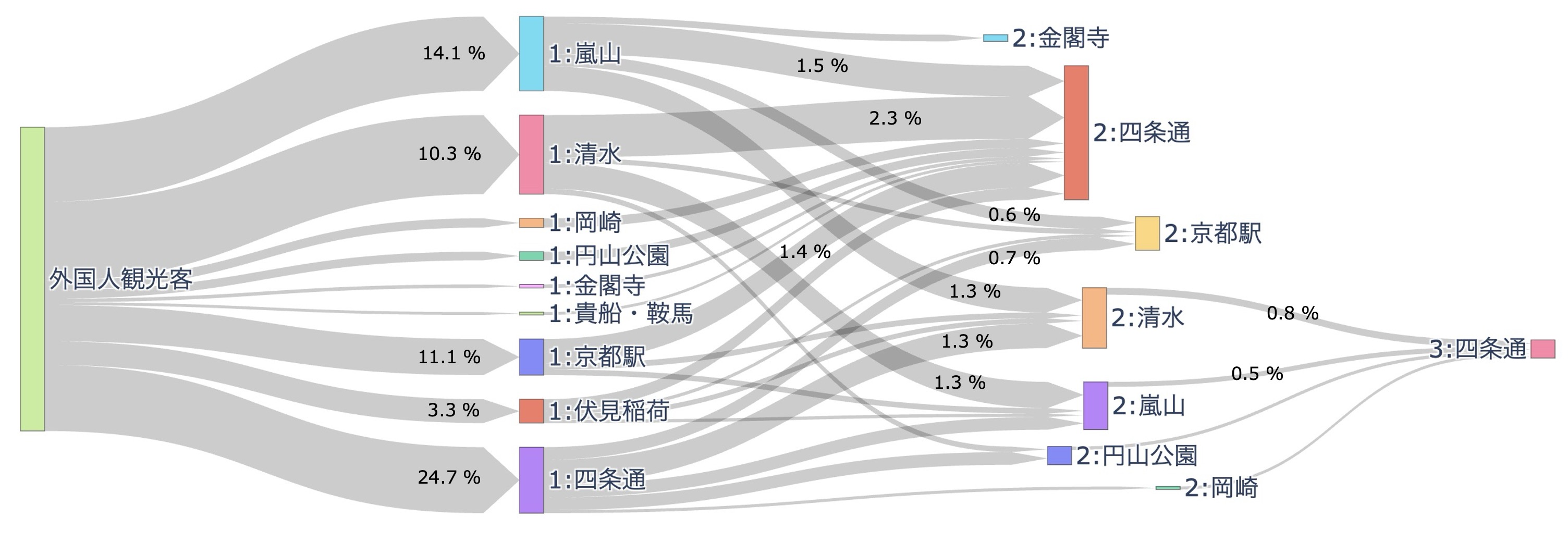 Figure 6: Tourist area tour by foreign tourists
As mentioned earlier, many Japanese tourists (approximately 36.2%) visit Shijo Street first, followed by Kyoto Station. The vast majority seem to end their day's sightseeing there. This 1: Shijo Street → 2: Kyoto Station itinerary accounted for about 1.5% of the total. On the other hand, a significant number of tourists (approximately 23.6%) visit Kyoto Station first, and most of them then visit Shijo Street. The 1: Kyoto Station → 2: Shijo Street itinerary accounted for about 2.1% of the total. From these two main itineraries, it can be seen that Kyoto Station and Shijo Street are frequently visited alternately. Furthermore, it appears that most tourists visit a maximum of two tourist areas in a day, and at most around three. The end of their day's sightseeing is either Kyoto Station or Shijo Street. From this, it can be inferred that for Japanese tourists, the end of their day involves either returning home from Kyoto Station or staying overnight near Kyoto Station or Shijo Street.
For foreign tourists, the most common starting points for their day are Shijo Street (approximately 24.7%), Arashiyama (approximately 14.1%), and Kiyomizu (approximately 10.3%). Kyoto Station, which was popular among Japanese tourists, is less common among foreign tourists. The next destination is most often Shijo Street, with approximately 5.2% of tourists visiting Arashiyama, Kiyomizu, or Kyoto Station first, and then heading to Shijo Street as their second stop. Kiyomizu and Arashiyama are also popular as second destinations. Looking at the first and second destinations, Arashiyama, Kiyomizu, and Shijo Street appear to be popular in both cases, and it can be seen that many tourists who visit Arashiyama first head to either Kiyomizu or Shijo Street next, indicating a tendency to visit two of the three areas in one day. This is an interesting difference from the aforementioned Japanese tourists, who alternated between visiting Kyoto Station and Shijo Street. Furthermore, most foreign tourists visit up to two places in a day, with very few visiting three. Furthermore, they almost always end their day on Shijo Street, suggesting that they are visiting for overnight stays.
lastly
This time, as an example of GeoTechnologies, Inc.' efforts in people flow analysis, we introduced a survey that focused on the similarities and differences between Japanese and foreign tourists' behavior in Kyoto. This report only presented a small part of the survey results, but people flow analysis can also be used to conduct even deeper investigations, such as which shops on Shijo Street are popular, what routes tourists take when moving between tourist areas, and whether Japanese tourists really head home from Kyoto Station or stay overnight on Shijo Street.
By utilizing these people flow analysis technologies, we can open up new avenues for solving challenges in tourism policies, such as attracting tourists and addressing overtourism. For example, we are already working on route suggestions aimed at reducing congestion and people flow monitoring services. GeoTechnologies, Inc. will continue to improve its people flow analysis technologies to support the resolution of various challenges.
(Written by: Ikeda, Digital Data Analytics, GeoTechnologies, Inc.)
Inquiries regarding services for corporate clients
For inquiries, please click here.
Related Services


Related articles
-
 2023.09.01Report
Enter the world of one of Japan's leading films at Ghibli Park: Insights into the impact of Ghibli Park on the local economy through people flow data and research.
-
 2026.10.13Report
Visitor potential in Ikata Town, starting with "awareness" and "food," as revealed by people flow data and surveys.
-
 2023.06.12Report
Is the "decline in car ownership" among young people real? Geo-Research reveals surprising results on Gen Z's car purchasing intentions! ~Popular car rankings for Gen Z and the Baby Boomer generation also announced~
