


What is autonomous driving (AD)? This article clearly explains how it works, the differences between levels 0-5, and how it differs from advanced driver-assistance systems (ADAS).



Self-driving buses attracted significant attention at the Osaka-Kansai Expo. Furthermore, with Toyota Motor Corporation launching its experimental city "Woven City," the entire automotive industry is seriously moving towards a self-driving society.
This article will provide a clear overview of the technologies and concepts behind autonomous driving, as well as the current state of practical application. It will also introduce how GeoTechnologies, Inc. is developing data and initiatives that can be utilized in autonomous driving.
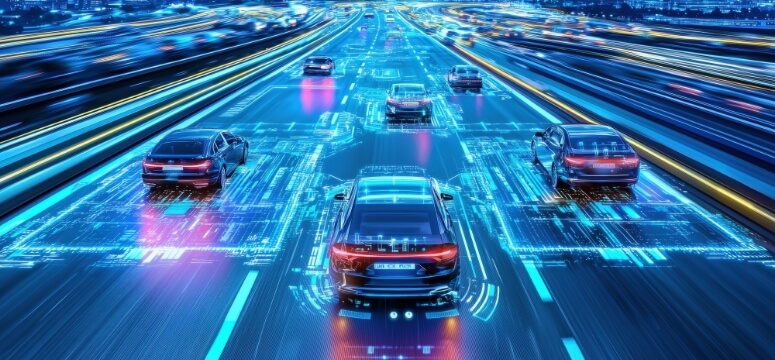
What is autonomous driving (AD)?
Autonomous driving refers to a technology in which a system performs a series of actions—perception, prediction, judgment, and operation—in place of the driver, allowing the vehicle to drive autonomously.
Vehicles equipped with autonomous driving technology are fitted with GPS, cameras, various sensors, radar, and other equipment to automatically control optimal driving operations while understanding the surrounding environment, such as lanes, surrounding vehicles, pedestrians, and buildings, in real time.
Autonomous driving technology is already being used in some commercially available vehicles, and efforts toward practical application are accelerating through collaboration between the government and private companies.
Classification of autonomous driving levels
Currently, the evolution of autonomous driving is classified into six stages, from "Level 0 to Level 5," depending on the type of technology installed.

Classification of autonomous driving levels (Source: Ministry of Land, Infrastructure, Transport and Tourism, "Regarding the Classification of Autonomous Driving Levels")
Differences between autonomous driving (AD) and advanced driver-assistance systems (ADAS) by level
A major concern is who is responsible if an autonomous vehicle is involved in an accident. There is a clear distinction between Level 2 and Level 3 autonomous driving.
Up to Level 2 of autonomous driving, it is considered driver assistance, and the primary responsibility lies with the "driver."
On the other hand, Level 3 and above are treated as autonomous driving where the vehicle is primarily responsible for driving, and in the event of an accident, the vehicle is held liable.
Currently, most of the autonomous driving technologies installed in vehicles sold in Japan fall under Level 2 or lower driver assistance systems (ADAS).
Therefore, current ADAS systems are merely functions to assist the driver, and the ultimate responsibility in the event of an accident rests with the driver.
GeoTechnologies, Inc. possesses high-precision maps for ADAS development and is committed to creating data that can be used in the ADAS field. For those interested in the importance of digital maps in ADAS, please refer to this document.
The initial stages of autonomous driving are at Level 3, while Level 4 and above enable driverless driving.
Level 3 is classified as "conditional driving automation," where the system continuously performs all dynamic driving tasks under specific conditions. While the system is operating, the driver is not required to monitor the surroundings of the vehicle, allowing for so-called "eyes-off" driving and a degree of relaxation inside the car. However, if the system becomes unable to continue operating, the driver must quickly take over driving, so activities that would render the driver unable to operate the vehicle, such as sleeping or drinking, are not permitted.
Level 4 is classified as highly automated driving, where the system continuously performs all dynamic driving tasks and even handles situations where continued operation becomes difficult within a specific area or under specific conditions (ODD: Operational Design Domain). At Level 4, autonomous driving without a driver is possible.
Level 5 is classified as fully automated driving, a level where the system operates autonomously under all conditions, without being restricted by driving area, speed, weather, etc. Efforts are underway to achieve this in the 2030s, but the technical hurdles remain high, and the timing of its realization is not yet clear.
GeoTechnologies, Inc. possesses high-precision maps and people flow data that can be used for autonomous driving. Please contact us here for more information.
Technologies required for autonomous driving (AD)
There are currently said to be eight essential advanced technologies for autonomous driving, which can be broadly classified into three categories: technologies that recognize surrounding information and the vehicle's position, technologies that make decisions on behalf of humans, and technologies that monitor the driver.
One of the goals of autonomous driving is to improve safety. If you are interested in examples of how data can be used to support the safety and security of automobiles, please see this document.

[Technology that recognizes surrounding information and the location of vehicles]
location technology
Location tracking technology is a technology that allows for highly accurate determination of "where a vehicle is at any given moment."
Current car navigation systems use GPS to determine location, but there can be an error of a few meters.
In autonomous driving, even a slight deviation in position can lead to an accident, so more precise positioning is required.
recognition technology
When self-driving cars operate on public roads, they need to accurately perceive their surroundings and use that information to decide on their next course of action. Essential to this is "recognition technology" that allows them to understand their surrounding environment.
Autonomous vehicles are equipped with multiple sensors, including cameras, radar, and LiDAR, which allow them to grasp and recognize information such as obstacles, pedestrians, the location of road signs and white lines, and road surface conditions in real time.
Communication technology
Communication technology is used to receive various infrastructure information such as traffic signals, road construction, and congestion, as well as to share the movements of one's own vehicle with surrounding vehicles.
Self-driving cars send and receive vast amounts of data while driving, making advanced communication technology essential. Among these technologies, "5G" is one that is already being implemented and is becoming widespread.
5G boasts features such as "high capacity and high-speed communication," "low latency," and "multiple simultaneous connections," and is expected to play a crucial role as the communication infrastructure for future autonomous driving.
[Technology that makes decisions on behalf of humans]
Prediction technology
Planning techniques
Data Processing Technology
[Technology for monitoring drivers]
Concepts for autonomous driving development
Autonomous driving relies on computerizing the processes of perception, judgment, and control. Sensors such as cameras understand the situation around the vehicle and recognize various objects such as other vehicles, pedestrians, and road signs.
Based on that information, the AI determines what controls should be implemented to ensure the vehicle is driven safely, and then communicates to the car what actions the computer should take according to those instructions. There are two main approaches to AI development: rule-based and end-to-end (E2E) based. Let's look at these two approaches.
Rule-based
In rule-based AI development, engineers define traffic rules one by one, such as "stop at red lights" and "don't cross the center line," and teach these rules to the AI. The AI then makes decisions based on these instructions.
However, real roads are full of irregular situations, and there are many situations where it is better to overlook minor violations and drive flexibly, or when pedestrians show no intention of crossing at a crosswalk, or when dealing with cyclists, which can make even humans unsure of what to do.
A weakness of rule-based systems is that the AI cannot respond unless all of these detailed decision-making factors are specified. It is necessary to define a vast number of scenarios, including rare cases, while incorporating information obtained from test runs, and to repeatedly train the AI.
When implementing autonomous driving in a new area, it becomes necessary to check each point specific to that region, which places a heavy burden on engineers. On the other hand, because the rationale for the actions is clear, there is the advantage that it is relatively easy to investigate the cause of problems and make improvements when they occur.
E2E base
The E2E (End-to-End) model is characterized by its ability to process the entire process from perception to control within a single model. By analyzing ambient information acquired from sensors within the model and directly outputting control instructions, it is said to mimic the process of human driving. As the name suggests, it is a system that handles everything "end to end" as a single integrated unit.
A large-scale neural network performs calculations and decisions based on sensor information in a single operation, and immediately outputs control signals, resulting in a simpler system configuration and enabling high-speed processing.
Its learning method is also distinctive; without the need for detailed definitions, the AI autonomously acquires the skills necessary for driving through a large amount of training data. It also has a high capacity to handle complex situations, including rare cases, and boasts excellent scalability and versatility.
As a result, E2E models have the potential to handle irregular situations and are expected to surpass human judgment capabilities. This represents a promising approach towards achieving Level 5 autonomous driving, which will enable autonomous driving regardless of the environment or driving area.
The future of autonomous driving (AD)
Both rule-based and end-to-end (E2E) systems have their strengths, and it's not a simple matter of one being superior to the other. Currently, rule-based systems are dominant from the perspective of safety and practicality, but it is thought that there will be a gradual shift towards E2E in the future.
In the early stages of development, E2E models have limited training time, making it difficult to improve accuracy. Rule-based models, which can guarantee a certain level of quality through definition, are therefore more practical. However, E2E models have a high potential to dramatically improve performance as training progresses, and are expected to significantly surpass rule-based models in the future.
The real challenge in autonomous driving isn't handling normal driving conditions, but rather dealing with irregular situations. The scope of these situations is enormous, and it's not realistic to create rules for every possible case. Currently, Level 4 services are feasible by limiting driving areas and scenarios based on rules, thus lowering the hurdles, but an E2E model has the potential to fundamentally solve this problem.
However, even when transitioning to E2E (end-to-end) systems in the future, we GeoTechnologies, Inc. believe that a system is needed that will not rely solely on sensor information, such as camera data, but will instead cross-reference it with high-precision maps and road infrastructure information to make decisions. We believe that by mutually complementing multiple types of information, safer and more reliable autonomous driving will be realized.
Companies interested in utilizing map data for autonomous driving (AD) and ADAS (Advanced Driver-Assistance Systems) are encouraged to contact us here.
Inquiries regarding services for corporate clients
For inquiries, please click here.

Related articles
-
 2019.11.28Introduction to Digital Maps
スケジュール帳+地図サービス?MapFanのプランニング機能、『おでかけプラン』
-
 2024.12.27Introduction to Digital Maps
This article introduces an easy way to find information on restrictions such as prohibiting large vehicles from entering certain areas, and showcases MapFan 's database of approximately 400,000 restriction records.
-
 2023.10.31Introduction to Digital Maps
地図の著作権とは?自社で地図整備制作を行っているMapFan(マップファン)が地図の著作権について説明します
