


What changes will come into effect in April 2026? An explanation of the key points of the new Trucking Law (Freight Motor Vehicle Transportation Business Law) and the amendments to the two logistics laws.



As the logistics industry addresses the "2024 problem" and labor shortages, major legal revisions related to logistics (the so-called "New Trucking Law" and "Revisions to Two Logistics Laws") came into effect on April 1, 2026.
Many people in charge of the industry may be wondering, "What exactly does our company need to do from April 2026?" and "What has changed with the new Trucking Law and the two Logistics Laws?"
This legal revision is divided into two aspects: one concerning "transportation operators and trading rules (New Trucking Law)," such as measures against the illegal use of unlicensed trucks and restrictions on multi-layered subcontracting (subcontracting); and the other concerning "shippers and logistics as a whole (Logistics Efficiency Law)," such as the designation of specific operators and the mandatory appointment of CLOs (Chief Logistics Officers).
This article will explain the key points of the "New Trucking Law," which came into effect in April 2026, while also clearly outlining the important aspects of the "Logistics Efficiency Law," which was enacted around the same time. Please use this as a reference to understand the changes your company needs to be aware of and the necessary countermeasures for the future.
This time, GeoTechnologies, Inc., which develops and provides road-related databases such as Vehicle type regulation, will explain in an easy-to-understand way the initiatives that hold the key to logistics DX. GeoTechnologies, Inc. provides a variety of data and services that support the efficiency of logistics necessary to reduce drivers' working hours. If you are interested, please contact us here.

- What are the new trucking law and the amendments to the two logistics laws?
- What has changed with the new Trucking Law and the amendments to the two Logistics Laws?
- Why is digital transformation (DX) required to comply with legal revisions?
- • A TMS (Transportation Management System) that is effective in complying with the Logistics Efficiency Law and the New Trucking Law.
- ·summary
What are the new trucking law and the amendments to the two logistics laws?
Background of its introduction
In recent years, the logistics industry has faced serious problems with long working hours due to the rapid expansion of the e-commerce market, the increase in parcel deliveries, and the aging of drivers. In response, based on the Work Style Reform Act, a limit on drivers' overtime work was applied from April 2024, and the overtime premium rate for overtime work exceeding 60 hours per month in small and medium-sized enterprises was raised to 50%. This is what is known as the "Logistics 2024 Problem."
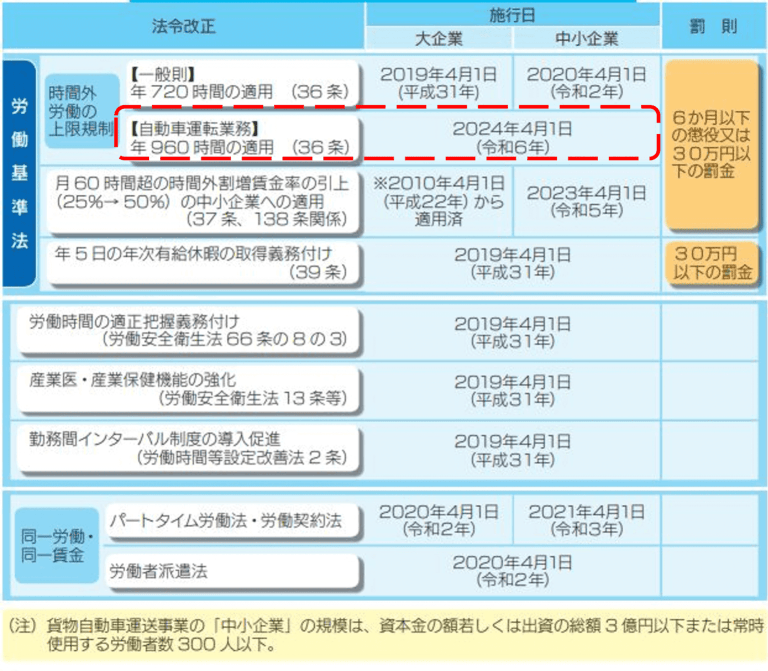
Source: All Japan Trucking Association, "Labor Relations Laws and Regulations Have Been Amended"
While these stricter regulations were expected to improve working conditions, concerns arose about reduced driver income due to shorter working hours and a brain drain to other industries. As a result, a serious driver shortage and a decline in transport capacity have occurred, raising concerns about the very maintenance of the logistics infrastructure. A series of legal reforms were introduced to fundamentally resolve these structural issues across the industry and to build a sustainable transport system.
Overview of the new Trucking Law and the amendments to the two logistics laws
In news reports and in practical business settings, terms like "new trucking law" and "amendments to the two logistics laws" are often used interchangeably, leading to confusion about the specific differences. Strictly speaking, they can be classified as follows, depending on the timing of the promulgation of the amendments and the laws they apply to.
Revision of the Two Logistics Laws (Logistics Amendment Law):
This refers to the amendments to the "Logistics Efficiency Improvement Act" and the "Freight Motor Vehicle Transportation Business Act," which were enacted in 2024. These laws aim to promote logistics efficiency and fair trade practices through the combined efforts of shippers and transportation businesses.
New Trucking Law (Two Laws for the Optimization of Trucking):
This refers to the "Partial Amendment to the Freight Motor Vehicle Transportation Business Act" and the "Act on the Establishment of a System for Proper Operation," both of which were promulgated in 2025. The Ministry of Land, Infrastructure, Transport and Tourism also refers to them as the "Two Laws for Proper Operation of Trucks."
Although the names and the timing of the enactment of the laws differ, both share the common goal of "addressing the logistics problem of 2024 and building a sustainable logistics system."
In practice, it's easier to understand the overall picture by considering it as consisting of two aspects: "transaction rules for transport operators (New Trucking Law/Freight Motor Vehicle Transport Business Law)" and "rules for improving efficiency for shippers and the entire logistics system (Logistics Efficiency Law)," rather than getting bogged down in minor differences in terminology.
When summarized precisely in chronological order, it is as follows:
| season | Legal amendment | Main contents |
|---|---|---|
| May 2024 | Enactment and promulgation of the revised Logistics Act | Logistical efficiency improvements, fair trade practices, etc. |
| April 2025 | Partial enforcement of the revised Logistics Act | Documents such as written delivery of transportation contracts and records of actual transportation operations. |
| June 2025 | Promulgation of two laws to regulate trucking practices | Measures to prevent illegal tigers, optimization of the number of contracts, etc. |
| April 2026 | Partial enforcement of the two laws regulating trucking and the revised logistics law. | Specific businesses, CLOs, countermeasures against illegal scammers, number of contracts, etc. |
What has changed with the new Trucking Law and the amendments to the two Logistics Laws?
With the implementation on April 1, 2026, the trading rules and business obligations surrounding the logistics industry have changed significantly. Here, we will explain the key points from two perspectives, focusing on the contents that came into effect on April 1, 2026: the "New Trucking Law (Amendment to the Freight Motor Vehicle Transportation Business Law)" and the "Amendment to the Logistics Efficiency Law."
Key points of the new Trucking Law (amendment to the Motor Vehicle Freight Transport Business Law)
The amendment to the Freight Trucking Business Act includes measures to ensure the sound operation and fair trade of the trucking business, such as streamlining the trading structure and reviewing business licenses. The main points are as follows:
1. Introduction of business license renewal system
The amendment will require business licenses to be renewed every five years. However, as of September 2026, this change has not yet been implemented, and specific renewal criteria will be determined by government ordinances and other regulations in the future.
Under the previous Freight Trucking Business Act, once a license was obtained, there was no need for renewal, and the business could continue indefinitely unless the license was revoked.
Key points of introducing a business license renewal system
- Safety measures, fair fares, and improved working conditions for drivers are required.
Businesses that do not meet the criteria may not be able to renew their licenses, potentially making it difficult for them to continue their operations.
- A system will be established that allows the Minister of Land, Infrastructure, Transport and Tourism to have independent administrative agencies carry out part of the renewal process.
Please note that the business license renewal system will not be implemented on April 1, 2026, but rather within three years of the law's promulgation on June 11, 2025.
2. Strengthening measures against white tigers
From April 1, 2026, the practice of entrusting the transportation of goods to unlicensed or unregistered drivers (so-called "white trucks") for a fee will be prohibited, and regulations will be strengthened. Shippers and others who violate these regulations may also be subject to penalties.
Before the amendment, there were no penalties for shippers who outsourced their work to unlicensed transportation companies.
Key points for strengthening measures against white tigers:
The Ministry of Land, Infrastructure, Transport and Tourism will be able to issue corrective orders, recommendations, and make public the names of companies that violate the regulations.
The shipper is responsible for verifying whether their trading partner's carrier has the necessary permits.
Transportation companies also need to "visualize" their reliability by presenting permits and obtaining G-mark certifications.
3. Limit the number of subcontracts.
Shippers and transportation companies are obligated to make efforts to limit subcontracting to at least two levels.
Before the amendment, there were no restrictions on the number of times outsourcing could be done, and a multi-layered subcontracting structure was commonplace.
The widespread practice of multiple layers of subcontracting—prime contractor → first-tier subcontractor → second-tier subcontractor, etc.—had created a structure where it was difficult for actual transportation companies to receive fair freight charges, posing a significant challenge.
Key points for reducing the number of subcontracts:
- The government will be able to request reports on the actual situation and frequency of subcontracting.
- In the event of violations or inappropriate outsourcing, the company may be subject to administrative guidance, recommendations, or public disclosure of its name.
- Strengthening of the system for understanding actual conditions and monitoring will be implemented to establish a proper trading structure.
The obligation to make efforts to limit subcontracting to the second tier or less came into effect on April 1, 2026.
4. Prohibition of charging below "appropriate cost"
Contracts that offer fares below the minimum fare based on the "appropriate cost" set by the government are prohibited.
Until now, freight rates were determined by free contracts between transportation companies, and excessive price competition had become the norm.
Key points regarding the prohibition of contracts below the minimum fare:
- The government will propose a "fair cost" that takes into account fuel costs, labor costs, vehicle maintenance costs, etc.
- Fare contracts below this minimum are illegal and subject to administrative guidance.
5. Improving the working conditions of workers
Under the new law, ensuring fair treatment for drivers will become a legal obligation for businesses, and the establishment of appropriate salary systems, performance evaluation systems, and training programs will be mandatory for transportation companies.
Prior to the amendment, while there were standards regarding drivers' wages and working hours, improving working conditions was merely a matter of best efforts, and there was no clear obligation to do so.
Key points for improving working conditions for workers:
The target includes not only truck transport operators but also freight forwarders (prime contractors).
- The status of improvements in working conditions is expected to be included in the review criteria when renewing permits.
Companies that fail to improve the working conditions of their drivers risk having their licenses not renewed.
If you are interested in three key points for solving route delivery challenges, such as regulations on large vehicles for medium- and long-distance logistics, please refer to this document.
For detailed information and explanations of the revised Freight Trucking Business Act (New Trucking Act), please see this article.
Key points of the revised Logistics Efficiency Law
The revised Logistics Efficiency Improvement Act establishes rules to encourage shippers and logistics operators to work together to reduce waiting times and improve transportation efficiency. From April 1, 2026, these rules became mandatory, especially for businesses above a certain size.
1. Reduce waiting and loading/unloading times.
There is a need to reduce the "waiting time" that truck drivers spend waiting for cargo to be loaded and unloaded, as well as the "loading and unloading time" spent on the actual work. The goal is to reduce waiting and loading/unloading times and shorten the time drivers are on duty by introducing truck reservation systems, staggering arrival times, and utilizing pallets.
2. Improving loading efficiency and joint distribution
Efforts are needed to reduce empty truck trips and low-load operations, and to transport goods efficiently with fewer vehicles. This includes reviewing delivery routes, arranging appropriate vehicle sizes, and promoting "joint delivery," where multiple shippers and businesses consolidate their goods for transport.
3. Designate businesses of a certain size or larger as "specified businesses."
From April 1, 2026, a system was introduced to designate shippers, warehouse operators, and transportation companies with an annual cargo handling volume exceeding a certain scale as "specified businesses (specified shippers, etc.)."
Companies designated as specified businesses are required to take the following actions:
- Preparation and submission of medium- to long-term plans to the government
- Periodic reports on the progress of medium- to long-term plans and actual measured values of loading and unloading times.
- Appointment of a company-wide executive responsible for promoting logistics efficiency, known as "CLO (Chief Logistics Officer)."
Failure to fulfill these obligations or demonstrably insufficient efforts may result in recommendations for improvement or corrective orders from the government. Failure to comply with an order, or failure by a specific shipper to appoint a CLO, may result in a fine of up to 1 million yen, as well as the possibility of the company's name being made public. Companies affected should check whether they fall under these categories and take planned measures accordingly.
Why is digital transformation (DX) required to comply with legal revisions?
Amidst the worsening restrictions on working hours and driver shortages stemming from the 2024 problem, digital transformation (DX) across the entire logistics industry is essential to adapt to the new rules established by the legal revisions and to build a sustainable logistics system.
The terms "DX" and "digitalization" are not necessarily used directly in the articles of the new Trucking Law or the Logistics Efficiency Law. However, utilizing digital technology is an effective means of ensuring compliance with the law and increasing its effectiveness in the field.
The system and logistics DX have the following complementary relationship:
- Legal reforms (New Trucking Law, Logistics Efficiency Law): These reforms establish order in trade and rules that must be followed throughout the industry through systems and penalties.
• Logistics DX: Utilizing technology to implement on-site improvement measures and ensure and visualize rule compliance.
Simply establishing rules is insufficient; continuing with traditional, analog operations such as paper-based daily reports, telephone communication, and manual vehicle dispatch planning will result in enormous management costs and only increase the burden on staff. As a result, even if the rules are followed temporarily, there is a risk that continuous operation will become impossible.
On the other hand, if technology is introduced without clear standards in the form of rules, it becomes unclear what the goal of efficiency improvements should be.
Now that the rules that must be followed by law have been clearly defined, it is crucial to promote logistics DX as a means to ensure their reliable implementation and continuity. Utilizing digital technology to improve operational efficiency not only complies with legal revisions but also directly contributes to improving drivers' working conditions and increasing corporate profitability.
A TMS (Transportation Management System) is effective for complying with the Logistics Efficiency Law and the New Trucking Law.
The use of a TMS (Transportation Management System) is an effective means of achieving the requirements of reducing waiting and loading/unloading times, improving loading efficiency, and improving working conditions that are mandated by the revised law.
A TMS (Transportation Management System) is a system that comprehensively manages and streamlines each process related to delivery, from dispatch planning and delivery progress management to the creation of driver reports. It is attracting attention as a system for promoting digital transformation (DX). Here, we will introduce three main functions.
① Dispatch management function
A TMS (Transportation Management System) provides features to support dispatching operations, such as assigning cargo to the appropriate transport company and vehicle. By utilizing the TMS's dispatch management functions, you can automatically select the most suitable transport company, vehicle type, transport temperature range, and transport mode (charter, consolidated, etc.) for your cargo.
By pre-registering available vehicles and drivers, it becomes possible to efficiently calculate delivery order, routes, and estimated arrival times for packages.
Furthermore, some TMS (Transportation Management Systems) are equipped with automatic dispatching and automatic loading (loading planning) functions, which are expected to further improve transportation efficiency.
Truck dispatch routes differ from passenger car routes, and it is crucial to create delivery routes that reflect the regulatory data applicable to each vehicle. This is because there are roads that are too narrow for trucks but passable for passenger cars, as well as roads with weight restrictions. GeoTechnologies, Inc. maintains and holds approximately 400,000 pieces of regulatory data, including road closures for large vehicles, weight restrictions, and vehicle height restrictions.
② Dynamic management function
The dynamic management function is a feature that allows you to track and monitor the transportation status of cargo in real time.
During transportation, important events such as "transit" and "delivery" occur, ultimately leading to "delivery completion." By monitoring the progress up to "delivery completion" in real time, it becomes possible to respond quickly to problems that occur and prevent delays from escalating.
Using the TMS (Transportation Management System)'s dynamic management function, even if unexpected accidents or traffic jams occur during delivery, you can check the vehicle's current location and take appropriate action, such as providing alternative routes or contacting the shipper.
The vehicle tracking function obtains real-time vehicle information via navigation and smartphones, allowing you to check the following:
- Vehicle's current location
• Progress of work
Furthermore, the collected vehicle data can be used in the following ways:
- Automation of driver daily report creation
・Utilizing driving history for safety management and promoting eco-driving
This will not only improve operational efficiency but also have a significant impact on safer driving and cost reduction.
③ Cost management function
The TMS (Transportation Management System) has a "cost management function" that allows for centralized management of expenses such as mileage and fuel consumption for each truck.
Delivery costs must be accurately calculated based on regional fare tables, taking into account various factors such as distance, delivery time, and surcharges for holidays, late nights, and winter. TMS's cost management function automates this complex calculation, deriving accurate delivery costs.
Furthermore, a system that can handle accounting processes, such as issuing invoices to shippers based on calculated delivery costs, would not only improve the accuracy and consistency of cost management but also significantly reduce the manual workload for accounting staff.
summary
The new Trucking Act (amendment to the Freight Motor Vehicle Transportation Business Act) and the amendment to the Logistics Efficiency Act, which came into effect on April 1, 2026, are important legal reforms aimed at resolving structural issues in the logistics industry, such as long working hours and driver shortages, and maintaining a sustainable transportation system.
To ensure that both shippers and transporters comply with the rules, reduce waiting times, improve loading efficiency, and establish a fair trading structure, it is effective to move away from analog operations at the operational level and promote "logistics DX" utilizing digital technology.
TMS (Transportation Management System) is considered a key tool for logistics DX (Digital Transformation). Delivery and fleet management systems require route search functions and maps showing truck locations. GeoTechnologies, Inc. offers a map API (MapFan API) that can be easily integrated into fleet management systems. For those interested in MapFan API please check our service description page.
We also offer a map database (MapFan DB) that can be integrated into your own system development. If you are interested in MapFan DB please see this service description page.
Accurate delivery requires traffic information. GeoTechnologies, Inc. publishes traffic information using people flow data on the map site MapFan. If you are interested, please click on "Beta Version Daily Traffic" in the upper right corner of the site below to check the traffic information.
Inquiries regarding services for corporate clients
For inquiries, please click here.
Related Services
-

MapFan API
You can use various search functions, such as map functions and route search, on our website and web system.
View service details
-
MapFan DB
Our highly reliable and proven digital maps can be widely used in standalone applications, internet-based applications, embedded systems, and more.
View service details
Related articles
-
 2023.12.21Introduction to Digital Maps
トラックステーションとは?ドライバーのオアシス、トラックステーションのデータを持つMapFanがご説明します
-
 2024.03.25Introduction to Digital Maps
What are the benefits of implementing dynamic management? GeoTechnologies, Inc. which possesses nationwide map data and people flow data, will explain in detail.
-
 2020.08.07Introduction to Digital Maps
Regarding map printing and usage: GeoTechnologies, Inc. offers a variety of professional map printing solutions!
