


What is delivery route optimization? An explanation of the challenges and efficiency improvements in the logistics industry.



In the logistics industry, improving the efficiency of delivery operations has become a major challenge, driven by factors such as the expansion of the e-commerce market, the increase in small-package deliveries, a shortage of drivers, and the need to comply with the revised logistics laws. Among these challenges, "delivery route optimization"—designing the optimal delivery route while considering factors such as destination, delivery time, vehicle conditions, and traffic conditions—is attracting attention.
Optimizing delivery routes can lead to reduced delivery times and distances, more efficient dispatching, lower fuel and labor costs, and improved delivery quality. However, there are many factors to consider, such as restrictions on large vehicles, road width, and traffic congestion, making it increasingly difficult to create optimal delivery plans based solely on experience and intuition.
This article introduces the challenges facing the logistics industry and the benefits of optimizing delivery routes. It also introduces GeoTechnologies, Inc.' map database "MapFan DB"and the map API service "MapFan API," which supports large vehicles, both of which are useful for optimizing delivery routes. Please refer to them for more information.
- ・Delivery route optimization means creating the most efficient delivery route according to the characteristics of the vehicle.
- What are the regulations on large vehicles that should be considered when optimizing delivery routes?
- Challenges in the logistics industry where optimizing delivery routes is required.
- Benefits of implementing a delivery route optimization system
- Key points for successful delivery route optimization
- ・ Optimizing delivery routes requires the use of map data, heavy vehicle restriction data, and people flow data.
Delivery route optimization is the process of creating the most efficient delivery route tailored to the characteristics of each vehicle.
Delivery route optimization refers to optimizing delivery order, routes, and vehicle dispatch plans to efficiently deliver to multiple destinations. It involves developing the optimal delivery plan while considering various factors such as delivery distance, delivery time, road conditions, vehicle characteristics, and safety. In the logistics industry, it is one of the important initiatives to improve delivery efficiency, reduce costs, and alleviate the burden on drivers.
When considering delivery routes, the "shortest distance" or "shortest time" is not always the optimal route. Routes suggested by general map apps and car navigation systems are often based on the assumption of regular passenger cars, and may not be directly applicable to large trucks or specialized vehicles used in logistics operations.
For example, large vehicles may not be able to pass under overpasses or tunnels with height restrictions. Also, some bridges and roads have weight restrictions, and depending on the load, passage may be prohibited. Furthermore, there are many conditions that must be considered when creating delivery routes, such as roads with width restrictions, sections where large vehicles are prohibited, one-way traffic regulations, and restrictions on vehicles carrying hazardous materials.
In recent years, the expansion of the e-commerce market has led to an increase in the number of deliveries, and the need to accommodate time-specified deliveries has made delivery planning more complex. Therefore, designing routes that take into account not only distance and travel time, but also large vehicle restrictions, traffic conditions, and vehicle-specific access requirements, is essential for improving logistics efficiency and ensuring consistent delivery quality.
Traditionally, creating delivery routes (dispatching) was typically done by experienced staff members who relied on their years of experience and local knowledge. However, due to the aging workforce and labor shortages, maintaining this expertise is becoming increasingly difficult. Furthermore, the increasing number of delivery destinations and the growing complexity of delivery conditions mean that relying solely on experience for route creation is no longer sufficient in many situations. Therefore, the importance of optimizing delivery routes using map data and information on restrictions on large vehicles is growing.If you are interested in large vehicle restriction data that can be useful for optimizing delivery routes, please visit this website.


What are the regulations on large vehicles that should be considered when optimizing delivery routes?
To optimize delivery routes, it is essential to create delivery routes that are tailored not only to the delivery destination and delivery time, but also to the characteristics of the vehicles used.
Unlike typical passenger cars, large vehicles such as trucks and buses are restricted to certain roads based on factors such as vehicle height, width, and gross vehicle weight. Therefore, creating a route based solely on the shortest distance or time may result in including roads that are actually impassable.
When creating delivery routes, it is necessary to consider road traffic laws and traffic regulations for large vehicles set by road administrators. Creating routes without considering these regulations may not only reduce delivery efficiency but also lead to legal violations and safety risks.
10types of large vehicle restrictionsto consider when creating delivery routes
When creating delivery routes for large trucks and buses, it is necessary to take into account the traffic regulations set for each vehicle type. Failing to consider these regulations when creating routes may result in routes that are actually impassable.
There are10 types of traffic regulations for large vehicles, which are particularly important for optimizing delivery routes and logistics systems.
1. Road closure for large freight vehicles, etc.
2. Road closure for large passenger vehicles.
3. Road closure for vehicles (including large vehicles) and other vehicle combinations.
4. Gross vehicle weight limit
5. Maximum load capacity limit
6. Vehicle width restrictions
7. Vehicle height restrictions
8. Prohibition of proceeding outside the designated direction
9. One-way street
10. Vehicles carrying hazardous materials are prohibited from passing.
For example, tall trucks may not be able to pass under elevated structures or in tunnels where height restrictions are in place, and they may not be able to pass on bridges with weight restrictions depending on the load. In addition, vehicles carrying hazardous materials may be subject to different regulations than those for general vehicles.
In this way, by utilizing appropriate regulatory data when creating delivery routes for large vehicles, it is possible to design safe and efficient delivery routes while complying with laws and regulations.
Furthermore, GeoTechnologies, Inc. isdeveloping Vehicle type regulation, including these 10 types of restrictions on large vehicles, for roads nationwide. By integrating this data into logistics and dispatch systems, it becomes possible to create delivery routes that take into account whether or not large vehicles can pass.
For detailed information on Vehicle type regulation please click here.
Creating delivery routes that take road width into consideration is also important.
Simply considering restrictions on large vehicles does not necessarily mean that delivery routes that are actually easy to drive will be created.
For example, even if a road is legally passable, the shape of the intersection and the width of the road may make it difficult for large trucks to turn right or left. Also, in residential areas and around industrial parks, there are many narrow roads where it is difficult for large vehicles to pass each other.
Veteran dispatchers who have been in charge of vehicle dispatching for many years have an empirical understanding of these road conditions, and in many cases, they create delivery plans while taking into account "roads that are legally passable but should be avoided in actual operation."
However, with challenges such as labor shortages and the personalization of tasks, it is becoming difficult to continue relying solely on the experience of individual employees for this kind of know-how. In order to optimize delivery routes, it is important to utilize road width data in addition to traffic regulation information and design routes that take into account the actual driving environment.
GeoTechnologies, Inc. also provides road width data, which is a database of road width information. This can be used to create delivery routes that take into account the passage of large vehicles and the ease of turning, as well as to improve logistics systems.
For more detailed information about road width data, please visit this website.
Challenges in the logistics industry where optimizing delivery routes is essential.
The need for optimized delivery routes stems from various challenges facing the logistics industry. The environment surrounding logistics is changing dramatically, includingincreased delivery demand due to the expansion ofthe e-commerce market, driver shortages, and the need to comply with revisions to two logistics laws. This article explains the main reasons why optimized delivery routes are necessary.
The increasing importance of delivery route optimization is growing with the rise of small-package deliveries.
With the spread of e-commerce sites and the establishment of flexible supply systems that respond to diversifying consumer needs, "small-lot deliveries," which involve transporting small quantities of goods to a single delivery address, are on the rise.
According to data from the Ministry of Land, Infrastructure, Transport and Tourism, the average cargo volume per shipment has halved in the last 20 years, while the number of shipments has almost doubled, indicating a rapid trend towards smaller and more frequent shipments.
As a result, the number of deliveries within the same delivery area has increased, placing a greater burden on drivers, who are required to handle time-specific deliveries and redeliveries for each destination. Furthermore, the loading efficiency per truck tends to decrease, leading to challenges such as increased delivery costs and higher CO2 emissions.
To meet the increasing demand for deliveries with limited personnel and vehicles, it is essential to optimize the order of visits to delivery locations and the routes taken, thereby reducing travel time and distance.
Source: Ministry of Land, Infrastructure, Transport and Tourism, "Distributed Materials from the 1st Study Meeting on Automated Logistics Roads, Document 3: Background of the Study (2) Current Situation and Challenges Surrounding Logistics"
Driver shortage puts pressure on dispatch operations.
Japan's working-age population is declining, and labor shortages are serious in every industry. The logistics industry, in particular, faces a major challenge in securing personnel due to long working hours and heavy workloads, resulting in a shortage of drivers and dispatchers.
According to a document jointly released by the Ministry of Economy, Trade and Industry, the Ministry of Land, Infrastructure, Transport and Tourism, and the Ministry of Agriculture, Forestry and Fisheries, the number of people engaged in road freight transport decreased by 213,000 over the 20 years from 1995 to 2015, and is projected to decrease by a further 248,000by2030.With the aging workforce also progressing, creating a system that allows for efficient delivery operations with limited personnel is essential to maintaining the logistics infrastructure.
Furthermore, from April 2024, regulations limiting overtime work for truck drivers came into effect. In addition, on April1,2026,amendments to the two Logistics Laws came into effect, and the designation of businesses handling cargo above a certain scale as "specified businesses" began. Specified businesses are required to take measures to improve logistics efficiency, such as reducing waiting times and loading/unloading times, and improving loading efficiency, and the responsibility for improving logistics has also expanded to shippers.
In the midst of these environmental changes, relying solely on traditional dispatching operations based on experience and intuition is becoming increasingly difficult. It is crucial to optimize delivery routes and utilize dispatching systems to establish a system that allows for efficient delivery operations even with fewer personnel.
GeoTechnologies, Inc.' map data is also used in many vehicle dispatch route planning systems. If you are interested in optimizing delivery routes or improving the efficiency of logistics operations, please also refer to our vehicle dispatch route planning system documentation.
Source: Ministry of Economy, Trade and Industry, Ministry of Land, Infrastructure, Transport and Tourism, Ministry of Agriculture, Forestry and Fisheries, "Study Group on Realizing Sustainable Logistics, Document 2: Current Situation and Initiatives Surrounding Logistics in Japan"
The increasing complexity of delivery and vehicle dispatch planning.
As logistics become smaller in size and more frequent, the number of factors to consider increases year by year, including the increase in delivery destinations, the ability to accommodate specified delivery times, and fluctuations in traffic conditions. In particular, urban areas are susceptible to road congestion, and a vast number of factors must be considered in order to create the optimal delivery route.
Furthermore, for large trucks, it's necessary to consider height restrictions, weight restrictions, width restrictions, and traffic regulations for large vehicles. Because routes must be created while considering not only the distance and travel time to the delivery destination, but also the roads that each vehicle can use, delivery planning becomes more complex.
Creating delivery routes manually, as in the past, requires a lot of time and experience. Furthermore, it is highly dependent on the judgment of individual employees, potentially leading to reliance on specific individuals and inconsistencies in route quality.
Therefore, in recent years, efforts have been made to create more accurate delivery routes by utilizing map data, heavy vehicle restriction data, and real-time traffic information. In particular, traffic congestion information has a significant impact on delivery times, making it an important factor in creating efficient delivery plans.
Benefits of implementing a delivery route optimization system

To streamline the delivery route creation process, which has traditionally been done manually, we recommend implementing a system that optimizes delivery routes. These optimization systems includetransportation management systems utilizingGIS (Geographic Information Systems) and systems equipped withAI. Here, we will introducethree main benefits of implementing such a system.
Reduced delivery time through optimized delivery plans.
Delivery route optimization systems are equipped with many features that support efficient route creation, so implementing them can reduce delivery times.
When creating routes using the system, various constraints are taken into consideration, such as delivery distance, delivery time, driver's working hours and assigned area, vehicle load capacity, road restrictions, and traffic congestion. Furthermore, the system derives routes by including information that tends to depend on individual experience, such as "roads accessible to large vehicles" and "building entrances," in order to shorten delivery times.
By utilizing GeoTechnologies, Inc.' map database "MapFan DB "and mapAPI"MapFan API,"it is possible to build a logistics system that can create delivery routes tailored to the specific requirements of each logistics company.
If you're not ready to jump straight into building a logistics system, you can use the route search function on the map site "MapFan" to create routes that incorporate regulations for large vehicles. It might be a good idea to try it out first to get a feel for the usefulness of a logistics system.
In addition to compiling approximately 380,000 traffic regulation data points for large vehicles across the entire country, the large truck route search allows users to set conditions such as whether or not toll roads are used, vehicle type, vehicle width, vehicle height, and gross vehicle weight, enabling a wide variety of route searches.
This prevents the dispatching process from becoming dependent on individual drivers.
Implementing a delivery route optimization system can prevent the reliance on individual employees for specific tasks. Traditional manual delivery route creation requires balancing various factors, inevitably relying on experience and intuition. Even when attempting to train successors, difficulties in recruitment and the transfer of information that is hard to articulate become challenges, leading to a tendency for tasks to remain dependent on veteran employees.
In this respect, introducing a delivery route optimization system will enable even inexperienced or unfamiliar-of-the-area personnel to create efficient delivery routes. Eliminating reliance on individual employees will improve the quality of work and allow for greater flexibility in responding to sudden employee absences or transfers.
Reduced labor costs through shorter delivery times
By implementing a delivery route optimization system, you can achieve efficient deliveries even with a reduction in the number of vehicles and drivers. Optimizing delivery routes shortens delivery times and reduces employee overtime.
Furthermore, by reducing the number of people and vehicles involved in the work, it is expected that running costs such as overtime pay, gasoline costs, and vehicle inspection fees can also be reduced.
Key points for successful delivery route optimization
Optimizing delivery routes is an important initiative that reduces the burden on those involved in logistics while also increasing the satisfaction of those receiving packages.
However, many factors must be considered when optimizing delivery routes, including the recipient's availability for delivery, vehicle load capacity, driver's assigned area, and traffic conditions. It is important to collect accurate information and make a comprehensive judgment based on the necessary conditions; otherwise, delivery may actually take longer.
Furthermore, some employees accustomed to traditional methods may be resistant to the introduction of the system. Unilaterally introducing a system without dialogue with those on the ground may lead to resistance, so it is important to carefully explain the purpose and benefits of systemization. It is also important to let them actually use the system through trials and training so that they can experience its convenience firsthand.
Optimizing delivery routes requires the use of map data, heavy vehicle restriction data, and people flow data.

Optimizing delivery routes requires the construction of a transportation system that accurately collects delivery-related information and enables comprehensive decision-making. By utilizing map data and centrally managing traffic restrictions, restrictions on large vehicles, delivery destination locations, and vehicle current locations, delivery route creation and dispatch operations can be made more efficient.
Furthermore, when creating delivery routes, it is important to consider not only the road network and traffic regulation information, but also the state of traffic congestion. Even on the same delivery route, traffic conditions can change significantly depending on the time of day and day of the week, so route design that reflects actual traffic conditions is required.
In recent years, by utilizing people flow data, it has become possible to visualize road congestion trends and traffic conditions at different times of the day, which were difficult to grasp with conventional traffic volume surveys. By using this data, it becomes possible to create more accurate delivery plans and optimize delivery routes while taking congestion into account.
GeoTechnologies, Inc. provides the map database "MapFan DB "and the mapAPIservice "MapFan API"to support the construction of transportation systems. We also provide people flow data utilizing over 1 billion mobile GPS data points collected daily from across Japan, which can be used for analyzing road usage and traffic congestion.
Furthermore, the map site "MapFan," operated by GeoTechnologies, Inc., also publishes real-time traffic congestion information for expressways using people flow data. This can be used for delivery planning and understanding traffic conditions, so please check it out if you are interested.
By combining map data, heavy vehicle restriction data, and people flow data, we can create more realistic and efficient delivery plans for optimized delivery routes. As the environment surrounding the logistics industry changes, the importance of transportation systems that utilize this data will only increase in the future.If you would like to learn more about GeoTechnologies, Inc.' map data, heavy vehicle restriction data, and people flow data, please contact us here.
Inquiries regarding services for corporate clients
For inquiries, please click here.
Related Services
-
MapFan API
You can use various search functions, such as map functions and route search, on our website and web system.
View service details
-
MapFan DB
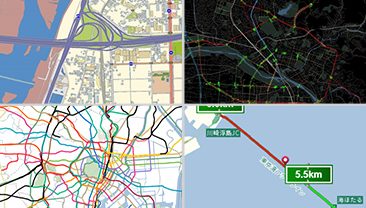
Our highly reliable and proven digital maps can be widely used in standalone applications, internet-based applications, embedded systems, and more.
View service details
Related articles


