


What is digital signage, which is changing the concept of billboard advertising? We will explain it in detail and in an easy-to-understand way.



Have you noticed recently that you often see displays showing directions and product recommendations at train stations, convenience stores, and other places?
These are media that display information and advertisements using displays called digital signage, and unlike conventional methods, they are characterized by their ability to dynamically display information and change the displayed content in a timely manner.
Recently, it has become possible to use people flow data to select effective locations for digital signage and to verify its effectiveness.
This time, MapFan will provide a detailed and easy-to-understand explanation of digital signage.

What is digital signage?
Digital signage refers to media that uses displays to provide advertisements and information. There are many different types, from large electronic billboards in Shibuya to small displays in supermarkets that show recipes.
Digital signage has become increasingly common in various locations as the cost of display terminals has decreased. Unlike print media, it allows for flexible content distribution as videos and images can be freely used and modified. Furthermore, digital signage equipped with touch panels has emerged, and interactive systems that respond to user input are also on the rise.
Furthermore, by utilizing people flow data, it has become possible to evaluate the effectiveness of OOH advertising (billboard advertising), including digital signage, which was previously difficult. We will explain this in more detail later.
We also offer an advertising effectiveness measurement service utilizing people flow data. If you are interested in measuring or improving the effectiveness of OOH (Out-of-Home) advertising, please visit our "Advertising Effectiveness Measurement" page.
Download for free now ▶︎"High-precision data analysis! A recommendation for an 'advertising effectiveness measurement service' that visualizes invisible effects"-- This document summarizes examples of effectiveness measurement reports and use cases derived from people flow data and surveys.
Advantages and points to note about digital signage
Until recently, digital signage was mainly seen in terminal stations and similar locations, but lately, its adoption in facilities and stores is increasing. This article will introduce the specific benefits of using digital signage, comparing it to paper posters and signs.
- Content can be displayed according to the situation.
Digital signage doesn't just display the same content all the time; it can instantly switch content depending on the time of day, day of the week, and other circumstances.
For example, it's possible to deliver information targeted at families during the daytime on weekends and information targeted at business professionals on weekdays. This timely switching of content allows for the delivery of information and advertisements that are more relevant to the target audience, resulting in a higher persuasive effect compared to static content.
Of course, it's also possible to display maps tailored to specific areas and events. If you're interested in map APIs usable with network-based digital signage,please contact our corporate support desk.
- Improving expressive abilities through the use of video
One of the major advantages of digital signage is the ability to utilize video content.
Information that is difficult to convey through text and images alone can be expressed more concretely by using videos and audio. Because it can provide much more information than traditional posters can, it is more effective at attracting the attention of passersby.
- Reduce replacement costs
Paper posters and handwritten signs require printing and replacing the content once they've been installed, which is time-consuming and costly.
On the other hand, digital signage allows you to change the displayed content simply by updating the content itself, eliminating the need for printing and installation, and thus offering significant cost savings.
Furthermore, unlike print media, a major advantage of digital signage is that it allows for the implementation and operation of advertising effectiveness measurement systems, making it easier to see the return on investment.
[Notes]
Traditional OOH advertising (billboard advertising) can be difficult to see in dimly lit areas with few streetlights, and sometimes requires getting close to see the content of the billboards or posters.
On the other hand, digital signage has the advantage of being easy to see even at night or in poor visibility conditions because of its bright screen. In particular, if a display with sharp image quality is used, the content can be clearly seen even from a distance.
Uses of digital signage
This section will introduce some of the actual applications of digital signage.
Advertising and promotion
Digital signage used for advertising and promotion includes those installed in stores and train stations, often used as an alternative to posters.
By displaying advertisements that are already being shown on other media (such as television and magazines), the media mix effect attracts the attention of passersby, and if dynamic video is also shown, it becomes even more memorable.
Furthermore, by changing the content displayed to match the demographics and time of day of the visitor, you can achieve even more effective advertising.
Information and guidance
Digital signage is often installed in General facility (public) and tourist destinations and used as information and guide signs. It is used as a digital guide that can change the displayed content according to the season and the visitors.
We can provide easy-to-understand information about the facility and directions to tourist attractions using videos and audio. In addition, digital signage equipped with touch panels can be operated by touching the screen, and some even offer multilingual guidance.
Are there any people considering installing digital signage who are also thinking about providing directions in foreign languages to foreigners visiting Japan?
MapFan 's maps can provide directions to stations, shops, and other locations in 13 languages. Please contact us if you are interested.
If you are interested in multilingual map displays, please contact us here.
• Attracting customers, sales promotion
By utilizing digital signage, you can effectively promote sales and event information with dynamic video, thereby attracting customers.
Furthermore, using videos to describe products makes it easier to visually convey the features and benefits of the product, which can encourage immediate purchases.
How digital signage works
There are two main types of methods for displaying content on digital signage. Understanding these differences is important because each method has different mechanisms, uses, and advantages. This article will introduce the characteristics of each type.
Network type
Network-based digital signage connects to the internet and distributes content via the internet. A key feature of this method is that the display content of signage installed on multiple displays can be changed remotely and simultaneously.
While content distribution requires an internet connection and equipment to receive the content, remote control and scheduled distribution significantly reduce operational effort. This is ideal for managing multiple digital signage displays centrally or for frequently changing the displayed content.
Standalone type
Standalone systems save created video and still image data to a USB memory stick or SD card, which is then inserted into the digital signage unit to play the content.
The disadvantage of this type is that the displayed content cannot be changed simultaneously on multiple devices. Every time the content is updated, it is necessary to go to the site and manually change the new data, which is time-consuming.
How to find effective locations for digital signage
For those considering implementing digital signage, one of the biggest challenges is determining the optimal placement to maximize its effectiveness. After all, it's pointless to install signage if no one walks by.
Therefore, by utilizing people flow data (Geo-People) provided by GeoTechnologies, Inc., it is possible to know in advance how many people pass in front of potential installation locations at different times of the day.
Furthermore, this people flow data can be associated with more than 10 types of detailed attribute information, including "gender," "age," "marital status," "living situation," "occupation," "educational background," "annual income," "number of children," "mode of transportation," and "interests."
By linking attribute information, it becomes possible to identify locations where the target customer base is likely to gather, enabling more effective installation of digital signage.
Selecting installation locations based on such attribute data, in addition to choosing locations based on foot traffic volume, is a powerful method for more accurately reaching the target audience and maximizing the effectiveness of advertising.
Basic knowledge about people flow data is summarized in the following document. For more detailed information, please refer to the document in conjunction with this article.
Measuring the effectiveness of digital signage using people flow data and surveys.
Many people struggle with evaluating the effectiveness of digital signage after installation.
Until now, evaluating the effectiveness of outdoor advertising (OOH advertising), such as digital signage and billboards, has been considered difficult due to the enormous costs involved.
However, by utilizing GeoTechnologies, Inc.' map data and people flow data, it is possible to evaluate the effectiveness of out-of-home (OOH) advertising efficiently, accurately, and at a low cost.
This document outlines the process for evaluating the effectiveness of out-of-home (OOH) advertising using people flow data from GeoTechnologies, Inc..
First, in order to narrow down the "estimated ad viewers" who may have come into contact with the advertisements displayed on digital signage, we use map data to identify locations and buildings where the advertisements are clearly visible, and determine the viewing area.
Subsequently, location-based people flow data is used to identify people who were in that area and screen them as potential ad exposure targets.
Next, we conduct a web-based survey (Geo-Research) targeting these estimated ad exposures to investigate their reactions and impact on the advertisement. By measuring and analyzing the effectiveness of the advertisement based on the collected data, we can improve our advertising strategy.
Furthermore, by distributing multiple advertisements to digital signage in different regions and conducting A/B testing, it becomes possible to identify the most effective advertisement and implement a PDCA cycle for OOH advertising (billboard advertising).
While this example focuses on outdoor advertising, this method can also be applied to measuring the effectiveness of digital signage installed in General facility (shop) such as department stores. This allows us to verify advertising effectiveness in a wide range of scenarios and support the maximization of advertising results.
Tips on how to utilize surveys and people flow data for marketing, as well as specific implementation steps, are summarized in the following document. Please refer to it in conjunction with this article.
Download "Survey to Maximize the Effectiveness of Geomarketing" for free.

In this article, we discussed digital signage, including how to utilize MapFan maps that support multiple languages for foreigners, how to select effective installation locations using people flow data, and methods for verifying effectiveness. We provided helpful information for implementing digital signage.
If you are interested in multilingual maps or people flow data, please feel free to contact us.
Inquiries regarding services for corporate clients
For inquiries, please click here.
Related Services
-
MapFan API
You can use various search functions, such as map functions and route search, on our website and web system.
View service details
-
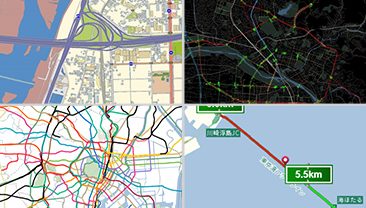
MapFan DB
Our highly reliable and proven digital maps can be widely used in standalone applications, internet-based applications, embedded systems, and more.
View service details
Related articles
-
 2019.03.25column
Why not take a tour of places associated with the story of the Forty-Seven Ronin?
-
 2020.04.17column
Exploring the Use of Digital Maps in Disaster News (Case Studies of Disaster Prevention System Map Data Adoption) — Real-time Reporting that "Saves Lives" —
-
 2025.11.24column
What is Advanced Driver-Assistance Systems (ADAS)? This article explains the differences between AD (Advanced Driver-Assistance Systems) and AD (Autonomous Driving), as well as their types and current status.
