


[Second Survey on Automobiles] BEV Owner Behavior Comparison: Is there a difference in the travel habits of owners of mini EVs and regular EVs like Teslas? Geo-Research reveals surprising survey results!



Recently, there has been growing interest in electric vehicles (EVs) when purchasing a car. However, do you think that people who prioritize using their cars in urban areas tend to prefer kei cars (mini EVs), while people who enjoy long-distance driving tend to choose regular-sized EVs?
As its second survey on automobiles, GeoTechnologies, Inc. conducted a questionnaire using Geo-Research, a research service that enables ultra-fast opinion surveys targeting owners of battery electric vehicles (Geo-Research). The results of investigating how far owners of light EVs and regular EVs travel revealed some unexpected findings!

Survey Implementation Overview
Research Objectives
To investigate the usage patterns of BEV owners, who are few in number and for whom large-scale surveys are difficult, a large-scale questionnaire (3,000 samples) will be conducted.
Research Method
The survey was conducted using the following two-stage method.
① To collect 3,000 responses from BEV owners, we will conduct a screening process by asking them to answer Question 1 with the name of the BEV model they own.
② Once the number of responses from BEV owners screened based on their answers to Question 1 exceeds 3,000, the questionnaire collection will be terminated and analysis will be conducted.
Total number of questionnaire responses collected
44,666
Number of BEV owner survey responses
3,009
Time required to collect survey data
13 hours 10 minutes
*September 21, 2023 17:00 - September 22, 8:10
SurveyQuestions
1. Model name of the BEV you own
2. Ask about their experience with en route charging and whether it was planned or accidental.
3. Questions about places where I have charged my phone and how to search for charging locations.
4. Ask for feedback on the availability of charging facilities.
5. Question about the reliability of the range displayed for BEVs.
6. Ask about the average distance traveled on weekdays and weekends.
7. Ask about the longest travel distance you have taken on weekdays or weekends.
Even with a narrow target audience of BEV owners, we acquired 3,000 samples in half a day!
First, before presenting the results of this survey, let me explain the screening survey for BEV owners.
In this survey, the initial challenge was finding BEV owners who could be included in the survey (screening survey), given that the penetration rate of BEVs in Japan is in the single digits.
While it is generally said that a survey can be valid with a sample size of 300-500, for this survey we set a major goal of conducting a survey of 3,000 BEV owners in order to clarify the actual behavior of BEV owners.
Before starting the survey, we estimated it would take at least a week to collect 3,000 samples, but in reality, we were able to collect 3,009 samples in just about half a day (13 hours and 10 minutes). A total of 44,666 survey responses were needed for this screening. We will explain more about Geo-Geo-Research, a service that enables such large-scale surveys to be conducted in such a short period of time, later.
If you would like to conduct an automotive-related survey, please click here >
Survey Response Results Report
1. Comparison of total travel distance between owners of light electric vehicles and owners of regular electric vehicles.
Now, let's move on to reporting the survey results. As mentioned above, this survey consisted of seven main questions, and we asked respondents to answer them. The sixth question, "Average travel distance on weekdays and weekends," revealed some unexpected results.
The graph below compares the total distance traveled by owners of light electric vehicles (light EVs) and regular electric vehicles (regular EVs) based on survey results.

Generally, I expected that owners of regular EVs, which have larger batteries and can travel longer distances, would have a lifestyle that involves traveling long distances, while owners of mini EVs would have a more compact lifestyle. However, the survey results showed that both mini EV owners and regular EV owners actually travel roughly the same distances.
Further investigation is needed to understand the differences in EV usage and attitudes between owners of regular EVs and owners of mini EVs, but the results were surprising.
2. On-the-road charging experience of owners of light EVs and regular EVs
Another interesting result emerged from a survey conducted among owners of light electric vehicles (EVs) and regular electric vehicles (EVs). It concerns the question, "Have you ever charged your vehicle while traveling?" Please see the table below.

It is often said that increasing the number of charging stations where drivers can charge their vehicles along the way is crucial for the widespread adoption of BEVs (Battery Electric Vehicles), allowing for convenient travel. However, our survey revealed that approximately 40% of BEV owners have never used roadside charging. Thissurprising result contradicts the common belief that expanding the number of charging stations for roadside charging is necessary for BEV adoption, suggesting that BEV owners primarily charge their vehicles at specific locations such as their homes or workplaces.
In particular, we assumed that many regular EV owners enjoy long drives, and therefore predicted that they would have more experience with charging along the way compared to owners of kei cars (mini EVs). However, the surprising result revealed that even among regular EV owners, "about 40% have never charged along the way."
These results suggest that we need to delve deeper into the actual charging habits of BEV users and the necessity of developing charging infrastructure.
3. Places where you have charged your device.
Looking at the survey responses regarding places where people have charged their devices, several typical patterns emerge. First, please see the survey results below.

First, the results showing that people are charging at highway service areas, parking areas, and roadside rest stops suggest that these are being used during long-distance drives. It's understandable that charging at these locations would rank highly as something necessary for long drives.
On the other hand, while charging at restaurants might seem like a more efficient use of time since it allows people to charge while they eat, the actual figure is a low 5%. Many charging spots have a rule that requires users to switch after 30 minutes. This limits usage to restaurants where meals can be completed in about 30 minutes, which likely explains the low utilization rate. Further research into the types of restaurants where charging is being used might reveal interesting insights into which types of restaurants would benefit most from charging spots.
Furthermore, the second most common method of charging is at car dealerships. Further investigation into the reasons behind this trend could potentially reveal strategies to encourage charging at dealerships and increase sales opportunities during waiting times.
Surprisingly, a large number of people are charging their devices in places like convenience stores, where they might only spend a short time, and in General facility (public) where they might not visit unless there's a specific reason. A closer examination of the reasons behind this could reveal unexpected behavioral patterns.
Information about these charging locations could provide clues to a deeper understanding of BEV users' charging habits and needs.
4. How to find a charging spot
Now, here are the results of a survey on what people use to find charging spots.

These results show that BEV owners use in-car navigation systems or apps provided by their car manufacturers. Many people use these apps because they allow them to easily search for charging stations for their BEVs. On the other hand, some people use general map apps like Google Maps, which they are already familiar with from their daily lives.
Further investigation revealed the existence of EV charging cards. The reason why people are searching using various methods rather than relying on any one method may be because they are using apps that make it easy to find locations where their contracted charging card can be used.
It was a surprising finding that people are using apps other than in-car navigation systems and car manufacturer apps to reliably search for charging locations for their BEV vehicles.
If you'd like to know more about what apps people are using besides those included in in-car navigation systems and apps provided by car manufacturers, please feel free to contact us.
For more detailed information on EV Charging Station click here >
Features of Geo-Research Geo-Research the service used in this survey
This survey was conducted using Geo-Research Geo-Research a survey service provided by GeoTechnologies, Inc..
Geo-Research will conduct a survey targeting users of the point-earning app "Torima." In addition to having a large number of active Torima users as monitors, Torima users can earn points by answering surveys, so they are eager to answer surveys as part of their point-earning activities. By conducting surveys with a large number of highly motivated survey monitors, we can collect a large number of responses in a short amount of time.
Furthermore, when registering as a survey panelist, we obtain consent to collect nine types of attributes: "gender," "age," "marital status," "living situation," "annual income," "household income," "family members living together," "children living together," and "main mode of transportation." Therefore, it is possible to conduct surveys targeting specific demographics such as gender, age, and income.
If you would like to conduct an automotive-related survey, please click here >

It can be combined with people flow data (Geo-People).
Since we obtain location information from the GPS of our survey panel users' smartphones with their consent, we can combine people flow data (Geo-People) obtained from this location information with Geo-Research, making it possible to conduct surveys on people who have visited specific areas, such as those who stopped at charging stations, which is difficult with other survey services.
Analysis results combining Geo-Research findings and people flow data
Here is an example of our analysis of people flow data compiled from those who responded to our recent Geo-Research survey.
We focused on the following two points and compiled people flow data, then combined it with the types of EVs owned, which were obtained from Geo-Research results. This allowed us to investigate how Geo-Research results, as revealed in "1. Comparison of total travel distance between light EV owners and regular EV owners," translate when analyzed in terms of actual travel.
◯Key elements of people flow data that we focused on
1. Number of days worked (especially for those who work many days)
2. BEV driving range and owner's mileage (median)
The following data was extracted from these elements.
• Median distance traveled
• Number of people who have driven more than 200km in a single day
• Number of people who have driven more than 300km in a single day
By combining this extracted data with BEV models identified through Geo-Research, we analyzed the driving range of BEVs on a full charge and the median travel distance of BEV owners, yielding the following results.
BEV driving range 100-200km: Median 20.35km
BEV driving range 200-300km: Median 16.274km
BEV driving range 301km and above: Median 18.14075km
These results show that there is no difference in the median distance traveled based on the BEV's range, and even when we correlated this using actual driving data, we found that, similar to the results from Geo-Research, "the motivation to travel does not change with driving range."
This time, we introduced some of the results of a survey conducted by GeoTechnologies, Inc. using Geo-Research on BEV owners. The survey results presented here are only a small part of the whole picture. If you would like more detailed information on these survey results, or if you would like to conduct a survey using Geo-Research on how BEV owners get around, or what factors are hindering the widespread adoption of BEVs, please contact GeoTechnologies, Inc..
If you would like to conduct an automotive-related survey, please click here >
Click here for details on Geo-Research Geo-Research
Click here for details on the people flow Geo-People data page >
Inquiries regarding services for corporate clients
For inquiries, please click here.
Related Services

Related articles
-
 2023.05.15Report
In a joint research project with the University of Tokyo, we analyzed people flow data and announced a ranking of "cities with high foot traffic"!
-
 2023.09.01Report
Enter the world of one of Japan's leading films at Ghibli Park: Insights into the impact of Ghibli Park on the local economy through people flow data and research.
-
 2026.02.04Report
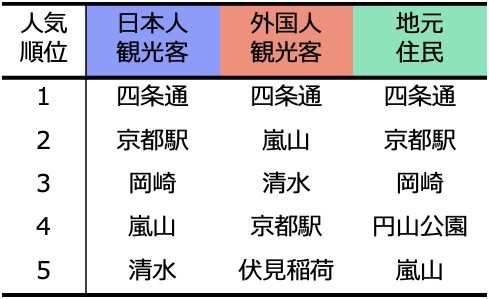
Investigating the Differences Between Japanese and Foreign Tourists in Kyoto Using people flow Data: Arashiyama and Kiyomizu, Popular with Foreign Tourists, and Shijo Street, Where Both Tourism and Local Life Concentrate.
