


[Corporate Inquiries Available] Regarding Printing and Secondary Use of Maps. MapFan explains the risks of copyright infringement of maps with examples.


We often use online map services without giving it much thought, but are you aware that printing those maps or posting them on your website involves copyright issues?
Maps are protected by copyright, and printing, reprinting, modifying, or publishing them without permission may constitute copyright infringement. Especially in commercial use, unknowingly using them without permission may result in risks such as fines and damage claims, so caution is necessary.
This article will cover basic knowledge about map copyright, methods for safely reusing maps, and usage rules for various well-known map services.
For those who wish to use maps safely in their business operations, or for corporations that wish to use them without copyright concerns, please feel free to contact GeoTechnologies, Inc. using the information below.
[For Corporate Clients] For inquiries regarding map printing and secondary use for business purposes, please contact us here.

Regarding copyright of maps
Maps, which we use daily on our smartphones and computers, are legally protected as "copyrighted works." This article explains the relationship between maps and copyright, including basic concepts and specific examples.
Maps are copyrighted works.
To fully understand why maps are considered copyrighted works, let's first review the definition of "copyrighted work" under copyright law.
Copyright law defines a "work" as an expression of an individual's thoughts and feelings. This includes literature, scholarship, art, music, and other forms of creative expression.
Article 2 (Definition)
1. A copyrighted work is a creative expression of thoughts or feelings that falls within the fields of literature, scholarship, art, or music.
(Copyright Law, Article 2, Paragraph 1, Item 1)
Maps (including digital maps) may appear at first glance to be mere pictures showing locations, but they are recognized as creative works protected by copyright law. This is because maps reflect the creator's ideas.
Maps can also be creative and innovative—what are the differences in presentation between Google Maps and MapFan?
Maps are not merely "things that show locations"; they incorporate different techniques and expressions depending on the service, and this uniqueness shapes their nature as copyrighted works.
For example, Google Maps displays building locations with icons and allows users to switch between regular map views and aerial or satellite imagery. Its key features include visual switching capabilities and simple operation.
On the other hand, MapFan uses car navigation map technology to employ a more visually appealing map design. In addition to displaying convenience stores and gas stations with company logo icons, users can switch between map designs depending on their purpose, such as printable, road-emphasized, antique map style, and RPG style.
MapFan 's map representation
<Reference>Printable design sample: Road emphasis design


You can view a list of maps from the features list on this page.
These visual differences are not merely "displays of geographical information," but rather "creative expressions" of each company, and therefore serve as grounds for them to be considered copyrighted works.
What happens if you infringe on the copyright of a map?
Maps are copyrighted works, and misuse can not only lead to legal liability but also severely damage a company's reputation. This article explains the main risks associated with copyright infringement from two perspectives: legal penalties and social impact.
1. Legal penalties
If you infringe on the copyright of a map, you may be subject to the following penalties, both as an individual and as a corporation.
- For individuals: Imprisonment for up to 10 years or a fine of up to 10 million yen (Article 119 of the Copyright Act)
- In the case of a corporation: If a representative or employee uses a map without permission for business purposes, the corporation may be subject to a fine of up to 300 million yen (Article 124 of the Copyright Act).
Furthermore, copyright holders may seek civil liability, such as claims for damages or claims for restitution of unjust enrichment.
2. Loss of social credibility
Unauthorized use of maps can have serious consequences, not only in terms of legal risks but also in terms of a company's social credibility. A lax attitude towards copyright can lead to serious consequences such as loss of reputation and damage to brand value.
For example, there was a case in which a map was posted on the official website of a municipality in a manner that violated the terms of use of a map information provider. In this case, when posting maps provided by Geospatial Information Authority of Japan and Google Maps on the municipality's website, it was pointed out that there was a possibility of violating the terms of use of the providers in terms of inadequate source attribution and the way the maps were handled. As a result, thousands of pages had to be removed and replaced, and we were forced to take action.
This case was picked up by the media, and it became widely known that even public institutions can become targets of public criticism if they violate copyright or terms of use.
In today's world, where compliance is paramount, copyright infringement can have a devastating impact on an entire business. Recovering lost trust can be time-consuming and costly.
For a detailed article on map copyright, click here >

Copyright and safe use of digital maps
As mentioned above, digital maps, like music and comics, are protected by copyright law as copyrighted works. The copyright of a map is owned by the company that maintains and produces the map data. Copying, redistributing, modifying, or otherwise using map data without permission, beyond the scope of the terms of use provided by the respective companies that hold the copyright to the map, constitutes copyright infringement.
It's important to note that the company providing the digital map service doesn't necessarily own the copyright to the map. In other words, "the map service provider = the copyright holder of the map" is not always true.
For example, if a company provides map services using the Google Maps or MapFan API in an app or website, the company providing the app or website is the map service provider, but the copyright holder of the map belongs to the company providing the API, Google or GeoTechnologies, Inc..
Now that we understand the basics of copyright, let's look at the usage rules for each map service. Understanding the rules for each major service is crucial for safe and effective use of maps.
Regarding the use of maps from Geospatial Information Authority of Japan
● Basic Usage Policy
Maps provided by Geospatial Information Authority of Japan (GSI Maps, topographic maps, etc.) are available for conditional free use based on Geospatial Information Authority of Japan own terms of use.
- Freely usable for websites, printed materials, presentations, etc., regardless of whether it is for commercial or non-commercial purposes.
● Points to note when using
Source attribution is mandatory. If the data has been modified, this must also be clearly stated, and publication in a manner that suggests it was created by Geospatial Information Authority of Japan is prohibited.
Examples of sources:
"Source: Geospatial Information Authority of Japan website (https://maps.gsi.go.jp/)"
"Source: Created by processing the topographic map of [location] published Geospatial Information Authority of Japan in [year]."
In some cases, separate permission may be required for specific uses, such as when primarily selling or publishing maps (e.g., selling atlases, creating calendars that mainly feature maps).
● Main examples of permitted use
- Displaying a background map on the homepage
- Facility maps in flyers and brochures
• Use in school teaching materials and academic papers
- Use in disaster prevention materials and local government newsletters
Source URL (Official Guidelines)
Geospatial Information Authority of Japan "Use of GSI Maps, Aerial Photographs, etc.":
https://www.gsi.go.jp/kikakuchousei/kikakuchousei40182.html
Detailed usage rules:
https://www.gsi.go.jp/LAW/2930-index.html
About using Google Maps
Google is often mistakenly perceived as a "free-to-use map," but misuse can lead to copyright and commercial use issues, so caution is especially necessary when using it for corporations or local governments.
● Basic Usage Policy
Google Maps is available for use under certain conditions, in accordance with Google's brand guidelines and terms of service.
- Embedding maps is permitted. However, you must use the embed code provided by Google exactly as it is.
● Important usage instructions
Embedding maps (using iframes) is generally permitted.
Google's "embed map" feature allows you to display maps on your website or blog. However, you must use the provided code without modification and do not remove the Google logo or credit information.
・Caution is advised when using screenshots.
While it's common to include screenshots of Google Maps in documents and presentations, you must, in principle, adhere to the brand guidelines. Removing logos or interface elements, or altering parts of the map, is prohibited.
- Use in printed materials (flyers, brochures, etc.) is also restricted.
While some degree of permission may be granted for non-profit or internal company use (with limitations on the number of copies), a license agreement may be required for commercial printing and distribution. Particular caution is needed when using materials or promotional items distributed to customers.
- Modifying map images or removing logos is strictly prohibited.
Removing the Google logo from a Google Maps screenshot or altering its design in any way is a violation of the Terms of Service.
● Points to note regarding commercial use
- In principle, Google Maps images (including screenshots) cannot be used in commercial printed materials, sales materials, advertisements, or promotional materials without Google's permission.
For example, flyers showing store locations and brochures with maps are examples of uses that should be carefully considered.
● Recommended usage
If you want to display a map on a webpage or blog, you must use an iframe embed code, and you must not modify it and leave the logo and credit as they are.
- When using screenshots in your materials, it is assumed that you will not remove the Google Maps logo or UI elements and will adhere to the brand guidelines.
Source URL (Official Guidelines)
Google Brand Resource Center:
https://about.google/brand-resource-center/products-and-services/geo-guidelines/
Google Maps Terms of Use:
https://maps.google.com/help/terms_maps.html
This page is about using and licensing the Google Maps API.
https://cloud.google.com/maps-platform/terms
About using OpenStreetMap (OSM)
● Basic Usage Policy
OpenStreetMap (OSM) is provided as "open map data" that anyone can edit and reuse, and is widely available for both commercial and non-commercial use.
- Use requires compliance with the terms of the Open Database License (ODbL), which is the license for OSM.
● Points to note when using
- Credit (attribution) is required.
When using a map, you must clearly indicate its attribution as follows:
"© OpenStreetMap contributors"
Alternatively, in Japanese, you could write something like "Source: Data from OpenStreetMap (© OpenStreetMap contributors)."
Commercial use is permitted, but you must abide by the license terms.
For example, when printing and selling maps, or embedding them in web applications or services, there are requirements such as proper attribution and the obligation to share data if modifications are made.
When using OSM map styles (tile images), you must also pay attention to the terms of use of each provider.
While the OSM data itself is free to use, the actual map images (tiles) may be distributed by external providers such as Mapbox, Carto, and HOT, each with its own terms of use.
● Recommended usage
- When displaying maps on websites or apps, include the text "© OpenStreetMap contributors" at the bottom of the display area.
When using OSM maps in your own documents or reports, always clearly indicate the source.
Source URL (Official Guidelines)
• OSM License Overview (in Japanese):
https://wiki.openstreetmap.org/wiki/Japan:OpenStreetMap_License
• Original license text (ODbL):
https://opendatacommons.org/licenses/odbl/
• Credit attribution guidelines:
https://wiki.openstreetmap.org/wiki/Attribution
Regarding the use of paid map services (such as MapFan)
● Features and benefits of paid map services
Features: A licensing and support system is in place to accommodate business use of maps (printing, distribution, processing, etc.).
·merit: Unlike free map services, this service is designed with commercial and secondary use in mind, making it a safe and reliable tool for corporate use. thing
● Strengths unique to paid map services
Comprehensive support for businesses
There is a corporate support desk where you can consult about how to use the maps and the scope of permission, and expert staff will answer any questions or concerns you may have.
Ease of obtaining permission
• General map services may require confirmation from multiple copyright holders or organizations.
Because we own and maintain our own map data, we can complete verification and usage applications smoothly.
GeoTechnologies, Inc., the operator of MapFan, is a map production company and service provider, so it is able to decide on permission and authorization at its own discretion.
Please feel free to contact us.
High reliability and compliance
- Because it can be used with copyright cleared, it avoids the risk of copyright infringement and violations, and is in line with the company's compliance awareness.
For business use involving printing, processing, and distributing maps, using free services carries a higher risk, making the use of paid services particularly effective.
● Differences between paid and free map services
Free map services (e.g., Google Maps, OpenStreetMap, etc.) are intended for limited use, such as personal use or embedding.
・ Paid services are designed for business use and commercial printing, and various usage methods are possible once a contract is agreed upon.
Paid maps offer a significant advantage over free maps in terms of peace of mind, as their use is contingent on a contractual agreement.
If you want to use a map service but aren't entirely confident after reading the terms of service, and want to avoid violating them, please consult with GeoTechnologies, Inc., the map professionals.
Click here for information on printing and using MapFan maps.
https://business.mapfan.com/service/print/
Regarding printing and secondary use of maps for business purposes
We have explained the risks of copyright infringement when printing, processing, or reproducing maps for business purposes, as well as the penalties, damages, and loss of social credibility that may result from such violations.
From here, we will look at actual usage examples to see "what specific tasks involve using maps" and "whether such use could potentially infringe on copyright."
Many people may think of maps as being limited to travel or personal route planning, but in reality, they are used daily in a wide variety of tasks. From the production of printed materials and application forms to local governments, to construction guides, sales materials, and the design of websites and landing pages, there are numerous situations where maps are treated as "copyrighted works" without us even realizing it.
Examples of printing and secondary use of maps that may infringe copyright.
- Using web map images in the draft of an informational flyer without permission, then printing and distributing it.
- Create official documents such as vehicle registration certificates by including map images and omitting copyright notices.
- Converting a document containing a map image to PDF format and publishing it without permission on a website.
- Unauthorized use of map images in publications or research reports.
For information on using GeoTechnologies, Inc.' business printing services, please click here >
Specific examples of commonly used business applications
Government offices and local authorities: Print maps for submission documents.
Even with advancements in digital technology, paper documents remain the norm for official submissions. In this context, it's common to see cases where printed maps are included with submitted documents. This is particularly true for legal professionals such as judicial scriveners and administrative scriveners, For companies that prepare numerous documents to submit to government agencies and local authorities, the ability to easily print maps through a system is extremely convenient.
Real estate company: Print a map of the property's location on the property flyer.
Map information is essential for property listings, flyers, and advertisements. These are often printed on paper and distributed via post, or converted to PDF format and distributed online.
Parking Permit: Print a map of the parking location.
When purchasing a car, a parking space certificate requires the attachment of a map. Even when administrative scriveners or dealerships handle this on your behalf, they are required to use maps appropriately. Printing maps from online map services without permission may infringe on copyright, so it is important to obtain permission from the copyright holder before using them.

Road and waterworks construction: Print maps of the construction sites and distribute them to residents in the surrounding areas.
When road or waterworks construction is underway, notices are distributed to nearby residents, and these notices include a map of the construction site. Since civil engineering and water/sewage companies often carry out construction in multiple locations, printing digital maps is very convenient for them. GeoTechnologies, Inc.' commercial map printing services are used by the four major general contractors.
Internal commute route confirmation: Print out and submit a map showing your route from home to work.
Many companies require employees to attach a map to their commute route application form. Even if it's for internal use, you need to check the terms of service and obtain the map in the correct way.

The use of maps in web design and marketing work is also increasing.
Corporate website and landing page: Display a map on the access page.
When displaying the location of a store or office on a company website or landing page, it is not uncommon for companies to use screenshots from map services without permission. Many map services have restrictions on saving, modifying, and posting screenshots, and violating their terms of service carries the risk of being asked to remove or replace the images later.
Furthermore, even when embedding maps, there may be restrictions on commercial use and display methods, so it is important to check the terms of service for each service and implement them correctly. Careless use can lead to unexpected problems, so prior confirmation and appropriate action are required.
Owned media and blogs: Images including maps are processed and edited for publication.
Inserting images created by taking screenshots of maps and editing them into an article may constitute copyright infringement. Particular caution is needed when modifying map images that show multiple locations or include route displays.
Proposal/Presentation Materials: Insert maps into sales materials
While it's common to include maps in sales and planning presentations, this can sometimes be treated as commercial use or redistribution, and screenshots from free services may violate their terms of use.
As you can see, the use of maps in business is surprisingly common in many everyday situations.
If you want to safely print and reuse maps, consider using a map service that has clear usage agreements and comprehensive support for businesses.
GeoTechnologies, Inc. offers a consultation service for corporations regarding the secondary use of maps.
Inquiries regarding services for corporate clients
For inquiries, please click here.
Related Services
-
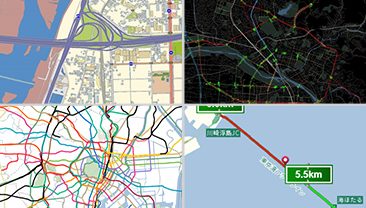
MapFan DB
Our highly reliable and proven digital maps can be widely used in standalone applications, internet-based applications, embedded systems, and more.
View service details
-

Printing and using maps
For business use of MapFan service maps, including printing and copying, please check here.
View service details
Related articles
-
 2023.08.30Introduction to Digital Maps
What is a dedicated bicycle lane? Explanation of signage differences and electric scooter compatibility | Examples of using bicycle routing data are also introduced.
-
 2026.01.20Introduction to Digital Maps
Autonomous driving will transform the logistics industry! An overview of the current state of autonomous driving initiatives!
-
 2026.07.23Introduction to Digital Maps
金融機関が見落としがちな「住所データ品質」の課題とは?顧客管理・担保評価・災害対応を支える住所DX
