


What is the 2024 logistics problem? What are the top 3 causes of truck driver fatigue? Truck navigation systems enable efficient delivery and reduce fatigue!


The term "Logistics 2024 Problem" has become increasingly common lately. The 2024 Work Style Reform Act is expected to bring about a complex set of challenges for Japan's logistics industry, including a predicted labor shortage and increased logistics demand due to the expansion of e-commerce. How to address this problem, which will shape the future of logistics, is attracting attention. This article will introduce key factors in discussing the Logistics 2024 Problem, such as the causes of truck driver fatigue, the challenges faced by logistics companies in addressing the problem, and large vehicle regulation data from GeoTechnologies, Inc. that supports efficient delivery in response to the Logistics 2024 Problem.
Furthermore, GeoTechnologies, Inc., the company that operates this website, develops and sells corporate-向け map products, including digital maps.
Logistics companies facing challenges in improving delivery efficiency and operational processes are welcome to contact us for a consultation.
For inquiries regarding GeoTechnologies, Inc.' corporate services, please contact us here.

- What is the 2024 logistics problem?
- • Logistics 2024 Problem: What is the estimated number of hours that can be worked per month after April 2024?
- Towards improving the working environment for drivers in order to address the logistics challenges of 2024
- • Data on regulations for large vehicles to reduce driver fatigue and improve delivery efficiency as a measure against the logistics challenges of 2024.
What is the 2024 logistics problem?
For many years, truck drivers have been forced to work long hours. In particular, the recent surge in home delivery due to the spread of online shopping has forced them to work even longer hours. To protect the health of truck drivers who are forced to work long hours, the Work Style Reform Act will be applied to the logistics industry from April 1, 2024, and an upper limit will be placed on the annual overtime hours of truck drivers. Both logistics companies and drivers are facing problems (concerns) as they comply with the Work Style Reform Act that will be applied from 2024. These problems faced by both parties are called the Logistics 2024 Problem.
2024What are the contents of the work style reform-related bills concerning the annual income problem?
As announced by the All Japan Trucking Association, This proposal limits the working hours of truck drivers to 960 hours per year. That's right. Moreover, This bill includes penalties.

Source: All Japan Trucking Association, "Labor Relations Laws and Regulations Have Been Amended"
Logistics Problem 2024: Problems on the Logistics Company Side
If a limit is placed on the annual overtime hours of truck drivers, the amount of cargo that a single truck driver can transport in a day will decrease, leading to a decline in revenue for logistics companies.
From April 1, 2023, the overtime premium rate for small and medium-sized enterprises (SMEs) exceeding 60 hours of overtime work per month was raised from 25% to 50%. This increase in the premium rate also applies to the logistics industry, and it has been pointed out that SME logistics companies may see increased labor costs and decreased profits. The "Logistics 2024 Problem" will have an even more severe impact on SME logistics companies.
Logistics Problem 2024: Driver Income Issues
If an annual limit is placed on overtime hours, truck drivers will see a reduction in working hours and health burden, but they will also face the problem of reduced overtime pay and consequently lower income.
Lower incomes diminish the attractiveness of the profession, increasing the risk of people leaving the truck driving industry. There are concerns that restrictions on overtime, coupled with a decrease in the amount of cargo one driver can transport per day, will further exacerbate the truck driver shortage.
One of the logistics problems of 2024 is the possibility that the shortage of truck drivers will become so severe that it will not be possible to transport all goods.
Logistics Problem 2024: What is the estimated number of hours that can be worked per month after April 2024?
Let's consider a guideline for a driver's working hours per month.
According to the guidelines of the All Japan Trucking Association, the standard for monthly working hours is as follows:
Assuming a month has 4.3 weeks, 22 working days, and a 1-hour break per day, if overtime is 80 hours, the total working hours for the month will be 274 hours.

Source: All Japan Trucking Association, "Action Plan for Realizing Work Style Reform in the Trucking Industry"
<Breakdown>
・Normal working hours: 40 hours per week × 4.3 weeks = 172 hours
Overtime work: Annual limit of 960 hours ÷ 12 months = 80 hours
• Break time: 1 hour per day x 22 days = 22 hours
However, there is a harsh reality that in fiscal year 2021, approximately 34% of businesses had monthly working hours exceeding 274 hours.
Towards improving the working environment for drivers in order to address the logistics challenges of 2024
Top 3 Causes of Driver Fatigue
To address the logistics challenges of 2024, it is necessary to improve the working conditions of drivers.
According to the "Report on the Actual Situation of Working Hours, etc., of Motor Vehicle Drivers" published by the Ministry of Health, Labour and Welfare, the top three causes of fatigue experienced by drivers are the following three:
1st place: There is road congestion.
When drivers get caught in traffic, they can't drive according to schedule, leading to stress, anxiety, and fatigue. It seems that this is often the case.
2nd place: Having a waiting time
The waiting time for receiving and transporting goods is inefficient for drivers, forcing them to waste time and causing fatigue.
3rd place: The presence of cargo handling work
Loading and unloading cargo is a task that puts a direct strain on the driver's body. Muscle fatigue seems to be particularly significant when handling heavy or large quantities of cargo.

Source: Ministry of Health, Labour and Welfare, "Report on the Actual Situation Regarding Working Hours, etc., of Motor Vehicle Drivers"
Top 3 problems that logistics companies find difficult to comply with regulations
Next, according to the "Report on the Actual Situation Regarding Working Hours, etc. of Motor Vehicle Drivers" also published by the Ministry of Health, Labour and Welfare, the top three issues that logistics companies find difficult to comply with due to the Logistics 2024 problem are as follows:
1st place: Waiting time for deliveries with first-time customers
Waiting time at the initial shipper, that is, at the first customer of the goods, is a major obstacle to efficient transportation operations.
2nd place: Waiting time at the consignee
Waiting time at the consignee, that is, the final destination where the goods are received, is also a factor that hinders the efficiency of transportation operations.
3rd place: Nothing particularly difficult
Surprisingly, about 30% of companies do not seem to have any concerns about complying with the regulations.

Source: Ministry of Health, Labour and Welfare, "Report on the Actual Situation Regarding Working Hours, etc., of Motor Vehicle Drivers"
30% of companies responded that they have no problem complying with the regulations.
Regarding "waiting time" and "loading/unloading work," which drivers consider to be causes of fatigue, adjustments with clients may be necessary and immediate improvements may be difficult. However, traffic congestion can be alleviated by adjusting routes to avoid congestion and avoiding peak hours. Taking steps to eliminate these causes of truck driver fatigue may be a solution to the 2024 problem.
To address the logistics challenges of 2024, data on regulations for large vehicles will be released to reduce driver fatigue and improve delivery efficiency.
To reduce truck driver fatigue, route guidance that takes both traffic congestion and restrictions on large vehicles into account is essential. Map data is what supports this.
1. Provides routes that take traffic congestion and road restrictions into consideration.
By suggesting routes that take traffic congestion and road restrictions into account in real time, we not only reduce stress and fatigue for drivers while they are driving, but also enable faster deliveries.
2. Development of data on restrictions for large vehicles
MapFan provides traffic restriction data for 10 different vehicle types, including road closures for large trucks, weight restrictions, and height restrictions. By using this data, you can avoid routes that are impassable for large vehicles.
3. Spot information for large vehicles
We also provide map data containing information on spots that drivers can use, such as parking areas and service areas specifically for large vehicles.
Inquiries regarding services for corporate clients
For inquiries, please click here.
Related Services
-

MapFan API
You can use various search functions, such as map functions and route search, on our website and web system.
View service details
-
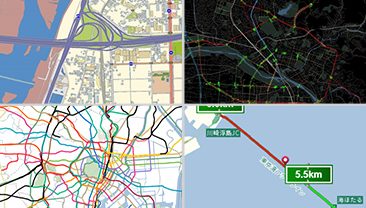
MapFan DB
Our highly reliable and proven digital maps can be widely used in standalone applications, internet-based applications, embedded systems, and more.
View service details
Related articles
-
 2019.04.22column
Walking around the famous cherry blossom spots in Tokyo made me reflect on history.
-
 2019.05.24column
Congratulations on the Reiwa era! Let's take a look back at Tokyo from the Edo period through each era.
-
 2019.03.25column
I visited some places in Tokyo associated with Saigo Takamori of the Satsuma Domain!
