


Ranking of things that trouble foreigners when they come to Japan [2025 latest]: The number one result is surprising? Challenges in inbound tourism revealed by the Japan Tourism Agency survey.



The number of foreign tourists visiting Japan continues to increase year after year, and in popular tourist destinations such as Tokyo, Kyoto, and Osaka, "overtourism," which includes the impact on residents' lives due to congestion and a decline in tourist satisfaction, has become a social issue.
On the other hand, the number of repeat visitors to Japan is also increasing. According to the latest survey by the Japan Tourism Agency, about 70% of respondents had visited Japan two or more times. These experienced repeat visitors are now venturing not only to the standard tourist destinations but also to local spots they found on social media and other platforms.
So, what exactly are the problems that these foreigners face when they come to Japan?
This article presents a ranking of the most common problems foreigners face in Japan, based on the latest survey results for fiscal year 2025 (Reiwa 7) published by the Japan Tourism Agency. In addition, GeoTechnologies, which provides people flow data and map data that can be used for tourism promotion policies, will explain the changes since fiscal year 2023 and the inbound tourism measures that local governments and tourism GeoTechnologies, Inc. should implement.
GeoTechnologies, Inc. provides comprehensive support, from promotions to store opening plans, based on domestic and international people flow data.

- Ranking of problems foreigners face when coming to Japan [Latest version for fiscal year 2025]
- How have the difficulties foreigners face in Japan changed? A 3-year comparison of the top issues.
- Have the difficulties foreigners face in Japan improved compared to seven years ago (2018)?
- - Address the lack of multilingual support! Multilingual MapFan maps are useful for local government's inbound tourism measures.
- ·summary
Ranking of problems foreigners face when coming to Japan [Latest version for fiscal year 2025]
The Japan Tourism Agency is conducting a "Survey on Improving the Environment for Receiving Foreign Tourists" to clarify the current state and challenges of the environment for receiving foreign tourists visiting Japan. The survey for fiscal year 2025 was conducted in person at five airports—Narita International Airport, Tokyo International Airport (Haneda), Kansai International Airport, Fukuoka, and New Chitose Airport—from November 2025 to January 2026, and responses were received from 4,110 people.
Now, let's look at the ranking of problems that foreigners encounter when they come to Japan.
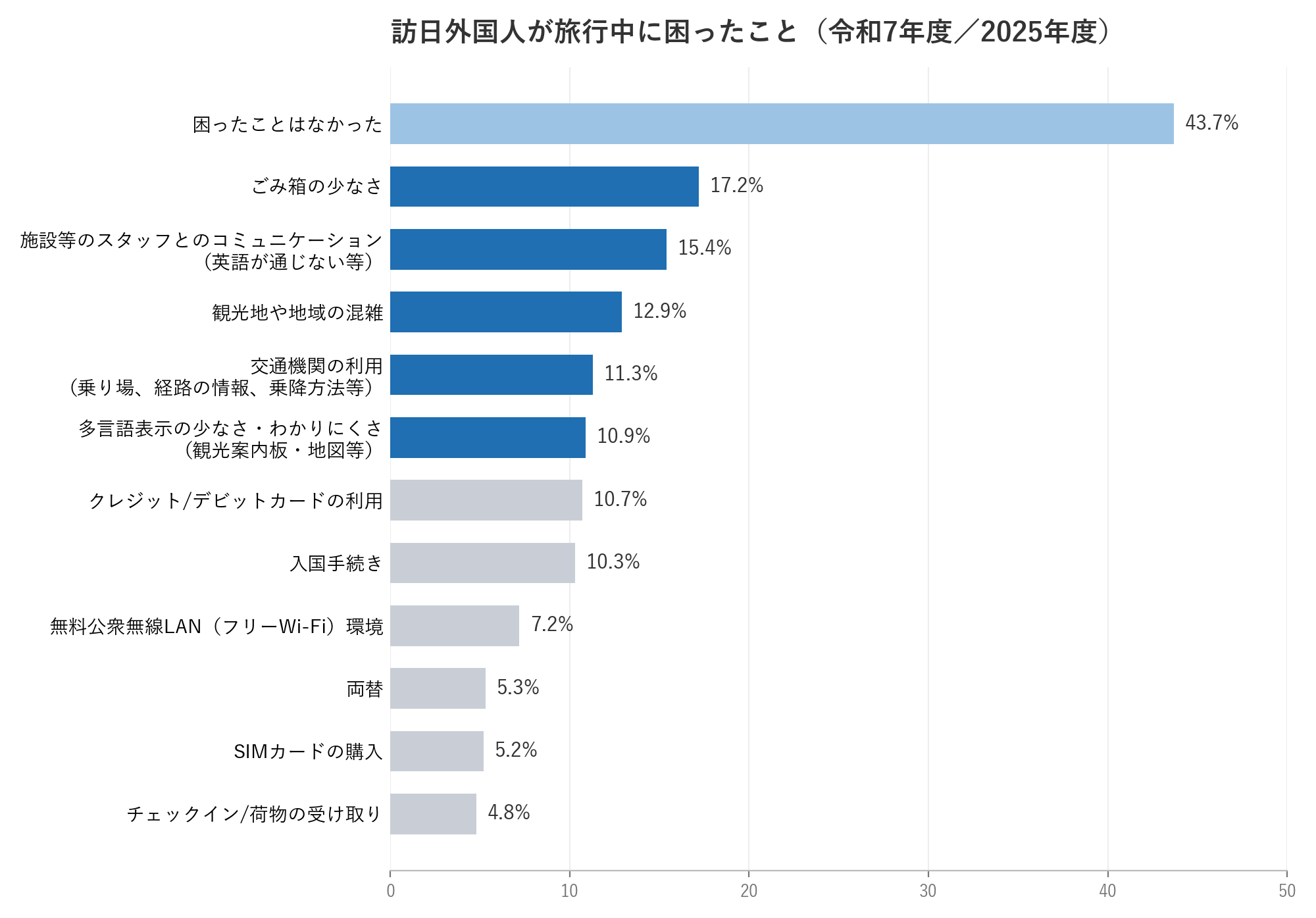
Source: Created based on the Japan Tourism Agency's "FY2025 Survey Results on Improving the Environment for Accepting Foreign Tourists Visiting Japan."
5th place... Use of public transportation (information on boarding locations and routes, boarding and alighting methods, etc.) (11.3%)
Many foreign visitors to Japan still find using public transportation such as trains and buses inconvenient. In urban areas, routes and transfers are complex and confusing, and in rural areas, information in foreign languages such as English is lacking.
The situation is still not satisfactory.
In fact, when asked about inconvenient modes of transportation, a high percentage of people in urban areas cite "railways other than the Shinkansen," while in rural areas, they frequently mention "buses." In addition to improving multilingual information at stations and bus stops, there is a need to create an environment where foreign travelers can research routes to their destinations themselves.
4th place... Overcrowding in tourist areas and regions (12.9%)
"Crowding in tourist spots and regions," a new addition to the 2024 survey, ranked fourth. The most common place where people experienced congestion was "tourist spots and tourist information centers" at 63%, and this figure was 60% for those who only visited urban areas, 14 points higher than for those who only visited rural areas (46%).
The most common problem reported was "difficulty moving around smoothly" (66%), followed by "not being able to see everything I wanted to see" (47%), "not knowing how crowded it was" (33%), and "unpleasant behavior due to poor manners" (23%). Online comments also included remarks such as, "Everywhere was overflowing with people, and I couldn't walk at my own pace."
To address overtourism, measures such as visualizing congestion levels and encouraging tourists to disperse to surrounding areas, including rural regions, are needed.
3rd place... Communication with staff at facilities, etc. (e.g., inability to communicate in English) (15.4%)
While some argue that Japanese people don't need to speak English, being able to communicate smoothly with foreign tourists is crucial for attracting inbound tourism.
The most common place where communication was difficult was "restaurants" at 38%, followed by "train stations and bus terminals" at 27%. When faced with difficulties, the most common response was "using automatic translation systems and ICT tools" such as translation apps by staff or travelers themselves (68%), while about 30% said they "gave up on communicating."
Translation apps and other technologies are improving year by year, and if used effectively, they can significantly lower language barriers. What's important is not whether you can speak a foreign language, but the willingness to communicate in that language, while also making use of tools.
2nd place... Lack of trash cans (17.2%)
In the 2023 survey, "lack of trash cans" was ranked first, but it dropped to second place. Japanese cities have a strong reputation for being clean, and it is thought that many foreign tourists have a strong desire to dispose of their trash properly. However, in reality, there are few trash cans in public places, and it seems that many people have difficulty finding a place to throw away their trash.
The places where the lack of trash cans was a problem were "tourist spots and tourist information centers," accounting for 70%, followed by "the route to tourist spots" and "train stations and bus terminals."
Currently, increasing the number of trash cans is difficult due to counter-terrorism and security concerns, as well as management costs. Maintaining cleanliness while balancing safety and hygiene will continue to be a challenge for tourist destinations.
1st place... I didn't encounter any problems (43.7%)
It may be surprising, but the most common response was "I didn't encounter any problems." This is a significant increase from 29.7% in 2023, and can be seen as evidence of progress in inbound tourism measures for foreign visitors, such as multilingual support and the provision of free Wi-Fi.
Furthermore, approximately 70% of respondents are repeat visitors who have visited Japan two or more times, suggesting that the increasing number of experienced travelers may also be a contributing factor.
However, this percentage is lower than in fiscal year 2024 (51.1%), meaning that more than half of the people experienced some kind of difficulty. We must not be complacent with the result that "no problems occurred," and further inbound tourism measures that convey a spirit of hospitality are needed.
By combining people flow data with surveys of people who have actually visited the destination, we can visualize tourist destinations using data.
How have the difficulties foreigners face in Japan changed? A 3-year comparison of the top issues.
Next, let's look at how the difficulties foreigners face in Japan have changed over the three years from fiscal year 2023 to 2025.
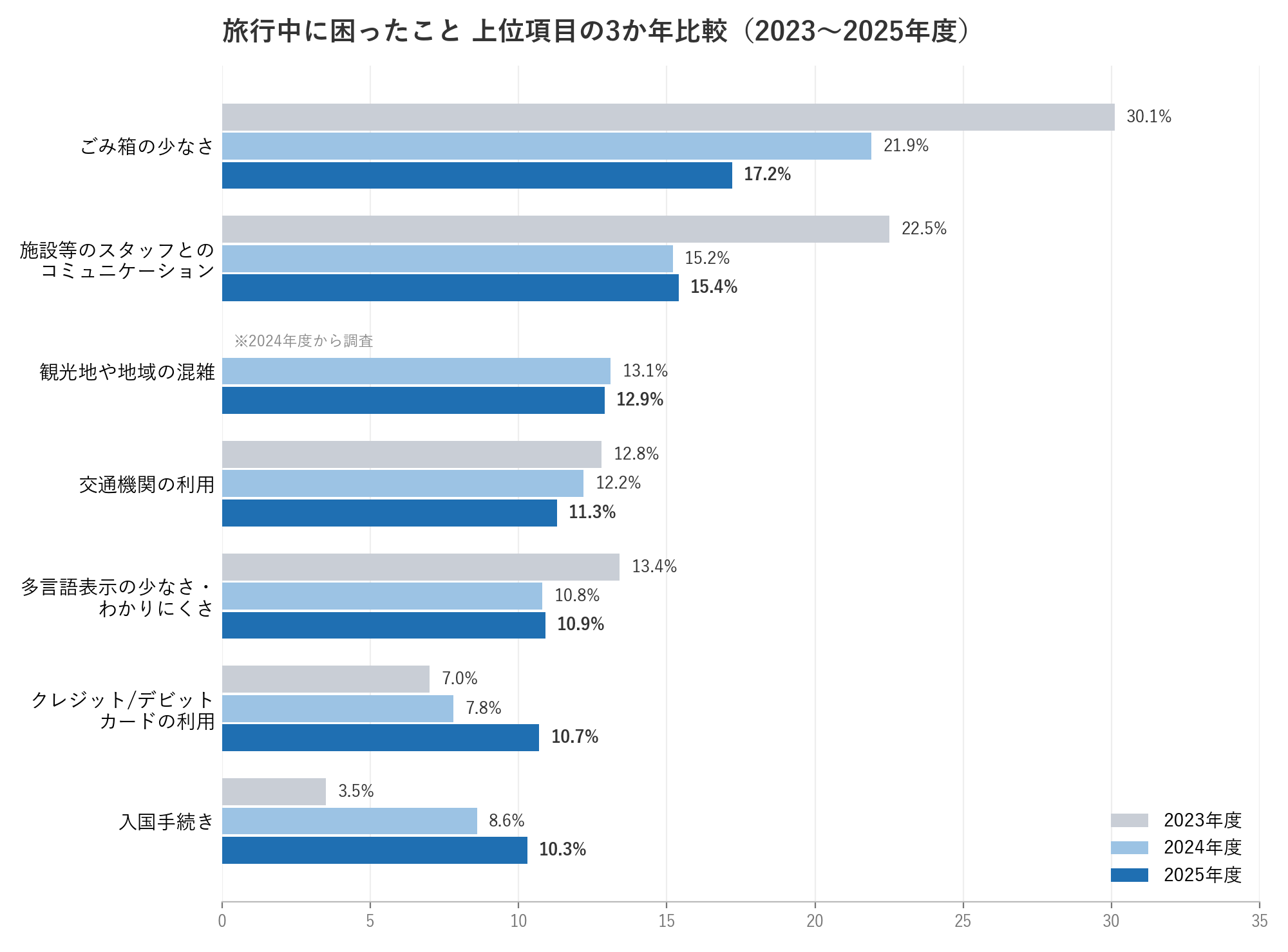
Source: Created based on the results of the Japan Tourism Agency's "Survey on Improving the Environment for Accepting Foreign Tourists Visiting Japan" for fiscal years 2023-2025.
The percentage of people experiencing difficulties with "credit/debit card use" has been steadily increasing since fiscal year 2023, and the percentage of people experiencing difficulties with "immigration procedures" has been increasing since fiscal year 2019 (Reiwa 1). In fiscal year 2025, these figures reached 10.7% and 10.3%, respectively, placing them 6th and 7th.
While "lack of trash cans" remains a top concern, it has decreased from 30.1% (FY2023) to 21.9% (FY2024) and then to 17.2% (FY2025), and the gap between it and other top concerns has narrowed.
-The percentage of people experiencing congestion in tourist destinations and regions remained almost unchanged, at 13.1% (FY2024) → 12.9% (FY2025), showing no decrease. The concentration of people in popular tourist destinations continues, and measures to address overtourism will remain an important issue going forward.
Issues such as "communication with facility staff," "use of public transportation," and "lack of or difficulty in understanding multilingual signage" have remained largely unchanged since fiscal year 2024. It can be said that difficulties related to language and guidance are still unresolved issues.
Have the difficulties foreigners face in Japan improved compared to seven years ago (2018)?
In this article, we have previously presented the results of the 2018 (Heisei 30) fiscal year survey. Comparing these results with the latest 2025 fiscal year results, we can see an overall trend of improvement.
| item | FY2025 | 2023 | 2018 |
|---|---|---|---|
| I didn't have any problems. | 43.7% | 29.7% | 36.6% |
| Communication with staff at facilities, etc. | 15.4% | 22.5% | 20.6% |
| Lack of or difficulty in understanding multilingual displays | 10.9% | 13.4% | 16.4% |
| Credit/Debit Card Usage | 10.7% | 7.0% | 10.0% |
| Free public Wi-Fi environment | 7.2% | 9.6% | 18.7% |
| Purchase a SIM card | 5.2% | 3.8% | 4.8% |
Source: Created based on the results of the Japan Tourism Agency's "Survey on Improving the Environment for Receiving Foreign Tourists in Japan" (Original Table 2)
The percentage of people who said they "didn't encounter any problems" rose from 36.6% to 43.7%. The biggest improvement was in the availability of free public Wi-Fi, which fell from 18.7% to less than half at 7.2%. The fact that Wi-Fi is now readily available in hotels, restaurants, and train stations, allowing travelers to look up necessary information on the spot, has contributed to increased convenience for travelers.
On the other hand, while "communication with facility staff" and "lack of or unclear multilingual signage" have improved, they still rank highly even after seven years. With travelers coming from various countries and regions around the world, and more people visiting places other than famous tourist spots, it is thought that there are still many places where multilingual support is not sufficiently advanced.
Solve the problem of limited multilingual support! Multilingual MapFan maps are useful for local government inbound tourism measures.
From here, we will offer suggestions to local government tourism officials on how to address the language difficulties faced by foreign tourists.
According to a survey by the Japan Tourism Agency, the places where visitors encountered difficulties with multilingual signage were "train stations" and "restaurants," both at 24%. Among those who visited only urban areas, "train stations" were the most problematic (30%), while among those who visited only rural areas, "restaurants" were the most problematic (23%). The most common problem cited was "lack of multilingual support/insufficient number of languages displayed," at 67%. Other complaints included dissatisfaction with the content, such as "less information than the original" and "mistranslations."
Previously, English was the primary language used for foreign language support. However, in recent years, tourists have been visiting not only from East Asia, but also from Southeast Asia (such as Thailand, Malaysia, and Indonesia), Europe, and around the world. Since it's not realistic to have staff who can speak every language, making tourist information boards, maps, and digital signage multilingual and creating an environment where tourists can obtain information themselves is an effective inbound tourism measure for local governments.
MapFan 's multilingual maps, supporting 13 countries and 14 languages, cater to inbound tourists.
That's where MapFan 's multilingual maps, which support 13 countries and 14 languages, come in handy. By creating an environment where foreign travelers can view maps and tourist information in their own language, it helps to alleviate the problem of "lack of or difficulty in understanding multilingual displays."
For example, by linking MapFan 's multilingual maps with digital signage to provide tourist information, tourist spots and directions can be displayed in the traveler's native language. By also introducing recommended local restaurants and souvenir shops, travelers can be smoothly guided to these establishments, leading to increased local spending. This approach offers benefits to both tourism and the revitalization of the local economy.
You can view sample maps in 13countries and 14languageshere.
Furthermore, by utilizing the people flow data provided by GeoTechnologies, Inc., it is possible to understand the flow of people in each area and time of day in advance. This can be used to identify places and times when people gather in large numbers, to consider effective locations for digital signage, and to identify areas prone to congestion and guide visitors to nearby tourist spots, thus helping to combat overtourism.
Furthermore, by combining people flow data with research services, it's possible to verify the actual effectiveness of digital signage. This allows for identifying areas for improvement after installation and further optimization.
The multilingual taxi app "S.RIDE" also uses MapFan API
According to a survey by the Japan Tourism Agency, the most common difficulty foreign tourists encountered when using public transportation was "searching for routes to their destination," cited by 45% of respondents. Many foreign tourists feel anxious about getting around due to language barriers and unfamiliarity with the area.
Amidst this situation, the number of foreign tourists using taxi apps as a means of transportation is increasing. One such taxi app that can be seen frequently around town is "S.RIDE." S.RIDE uses a map API (MapFan API) provided by GeoTechnologies, Inc.. With accurate location information and directions, even foreign tourists unfamiliar with Japanese geography can easily set their destination and travel with peace of mind.
For SIers: Please contact us hereregarding map services for ride-hailing app development.
summary
This time, based on the latest survey by the Japan Tourism Agency, we've ranked the things that foreigners find difficult when they come to Japan.
In fiscal year 2025, "I didn't encounter any problems" accounted for 43.7% of responses, making it the most common response, indicating an improving trend in the environment for accepting tourists compared to fiscal year 2018. On the other hand, "lack of trash cans," "communication with staff at facilities," "crowding in tourist areas and local communities," "use of public transportation," and "lack of or difficulty in understanding multilingual signage" continue to rank highly. In particular, problems related to crowding and language remain stable, suggesting that measures against overtourism and multilingual support will be major themes for future inbound tourism strategies.
By utilizing the multilingual maps, people flow data, and research services provided by GeoTechnologies, Inc., you can consider data-driven and effective solutions to these challenges. If you are interested, please feel free to contact GeoTechnologies, Inc..
Source: Japan Tourism Agency, Survey on the Current Status of the Environment for Receiving Foreign Tourists Visiting Japan
https://www.mlit.go.jp/kankocho/content/001998843.pdf
Inquiries regarding services for corporate clients
For inquiries, please click here.
Related Services


Related articles
-
 2020.09.24How to use digital maps
The importance of data utilization revealed by the COVID-19 pandemic. What is "civic tech," the philosophy of the digital age?
-
 2026.04.30How to use digital maps
What is POI data? Basic knowledge of point-of-interest (POI) information that supports map services.
-
 2026.04.30How to use digital maps
What is map matching? Explanation of its mechanism and applications.
